Exploring the Antennae
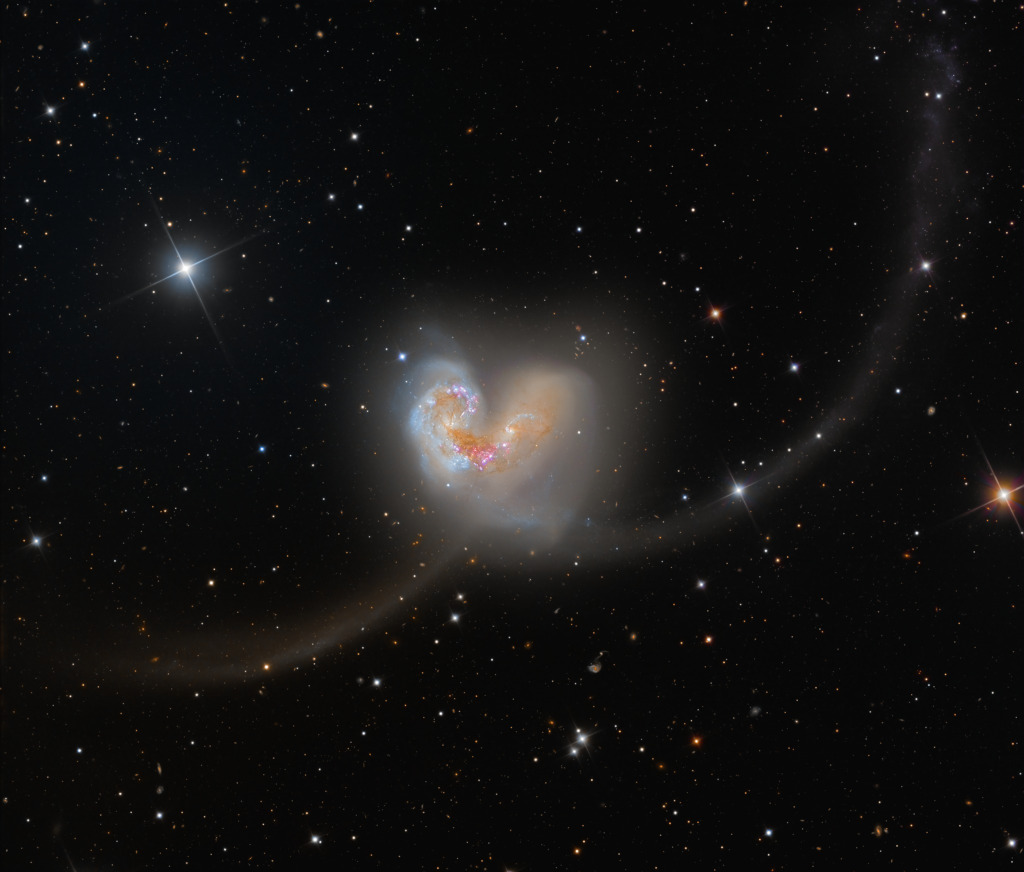
Some 60 million light-years away in the southerly constellation Corvus, two large galaxies are colliding. Stars in the two galaxies, cataloged as NGC 4038 and NGC 4039, very rarely collide in the course of the ponderous cataclysm that lasts for hundreds of millions of years. But the galaxies' large clouds of molecular gas and dust often do, triggering furious episodes of star formation near the center of the cosmic wreckage. Spanning over 50 thousand light-years, this stunning telescopic frame also reveals new star clusters and matter flung far from the scene of the accident by gravitational tidal forces. The remarkably sharp ground-based image follows the faint tidal tails and distant background galaxies in the field of view. The suggestive overall visual appearance of the extended arcing structures gives the galaxy pair, also known as Arp 244, its popular name - The Antennae.
Artemis II: Splashdown
Text from NASA APOD.
How to see it yourself
Antennae Galaxies (NGC 4038) — galaxy in the constellation Corvus.
- Best seen in February – April, when it stands highest around midnight.
- From New York it climbs to 30° above the horizon. Visible from latitudes -90° to 61°.
- Needs a 150–200 mm telescope and a dark sky outside the city.
- Constellation
- Corvus
- Magnitude
- 10,2m
- Apparent size
- 5,4′ arcminutes
Whether NGC 4038 is up for you tonight, and how the clouds and the Moon look — AstroTools shows it.