NGC 3310: A Starburst Spiral Galaxy
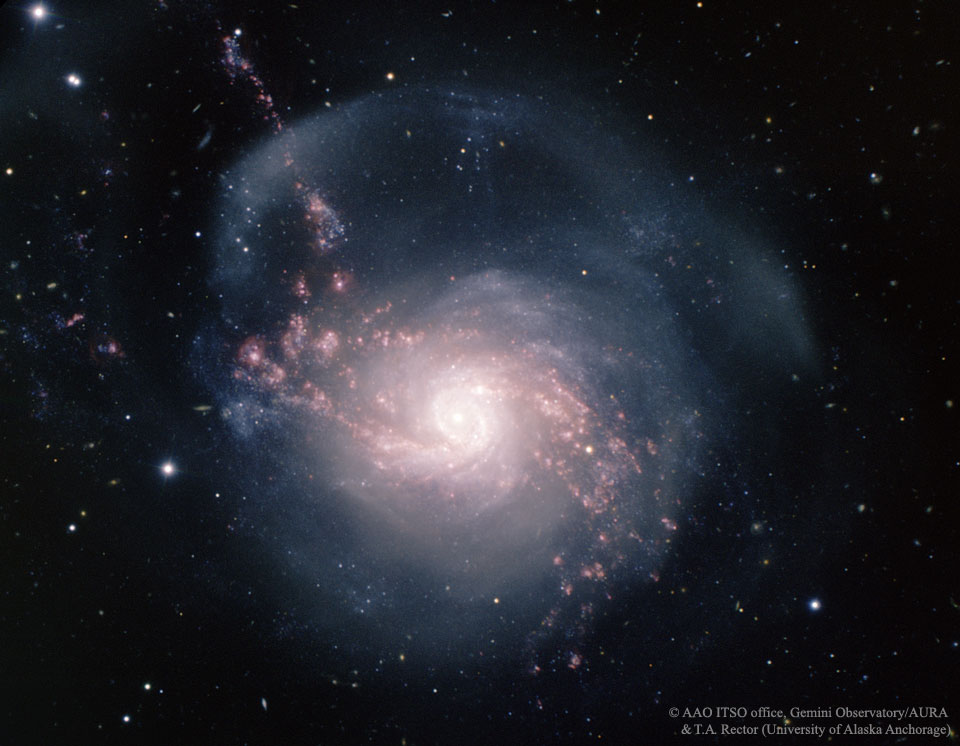
The party is still going on in spiral galaxy NGC 3310.
Roughly 100 million years ago, NGC 3310 likely collided with a smaller galaxy causing the large spiral galaxy to light up with a tremendous burst of star formation.
The changing gravity during the collision created density waves that compressed existing clouds of gas and triggered the star-forming party.
The featured image from the Gemini North Telescope shows the galaxy in great detail, color-coded so that pink highlights gas while white and blue highlight stars.
Some of the star clusters in the galaxy are quite young, indicating that starburst galaxies may remain in star-burst mode for quite some time.
NGC 3310 spans about 50,000 light years, lies about 50 million light years away, and is visible with a small telescope towards the constellation of Great Bear Ursa Major.
Text from NASA APOD.
How to see it yourself
NGC 3310 — galaxy in the constellation Ursa Major.
- Best seen in January – March, when it stands highest around midnight.
- From New York it never sets and climbs to 77°. Visible from latitudes -26° to 90°.
- Needs a 150–200 mm telescope and a dark sky outside the city.
- Constellation
- Ursa Major
- Magnitude
- 11,6m
- Apparent size
- 1,8′ arcminutes
Whether NGC 3310 is up for you tonight, and how the clouds and the Moon look — AstroTools shows it.