The Pelican Nebula in Gas, Dust, and Stars
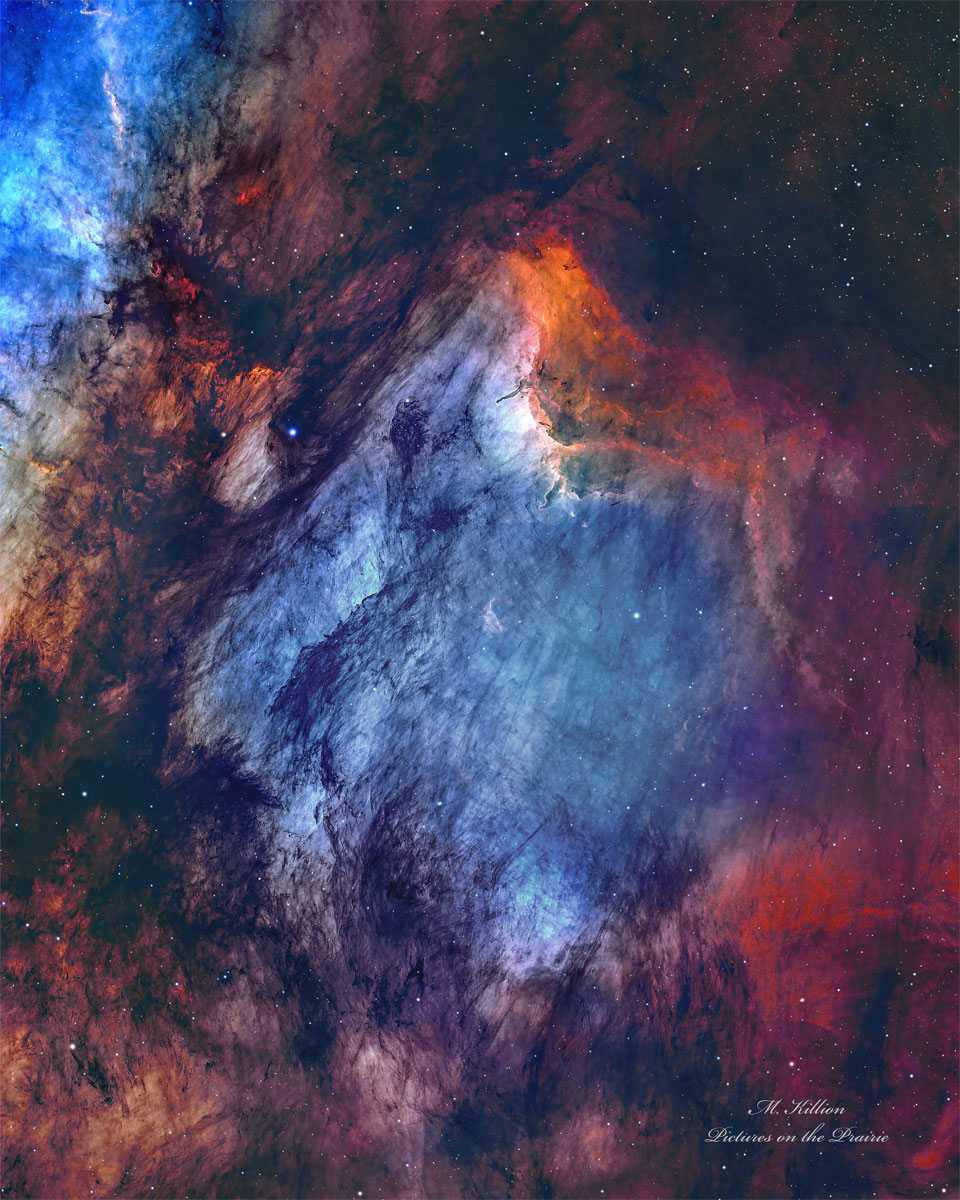
The Pelican Nebula is slowly being transformed.
IC 5070 (an official designation) is divided from the larger North America Nebula by a molecular cloud filled with dark dust.
The deep featured picture from Utah, USA incorporates 25 hours of exposure and brings out great details of this filamentary dust. The Pelican Nebula receives much study because it is a particularly active mix of star formation and evolving gas clouds.
The light from young energetic stars is slowly transforming the cold gas to hot gas, with the advancing boundary between the two, known as an ionization front, visible in bright orange on the upper right. Particularly dense tentacles of cold gas remain.
Millions of years from now, the Pelican Nebula, bounded by dark nebula LDN 935, might no longer be known as the Pelican, as the balance and placement of stars and gas will surely leave something that appears completely different.
APOD's main NASA site is moving: From apod.nasa.gov to science.nasa.gov/apod
Text from NASA APOD.
How to see it yourself
Pelican Nebula (IC 5070) — emission nebula in the constellation Cygnus.
- Best seen in July – September, when it stands highest around midnight.
- From New York it climbs to 86° above the horizon. Visible from latitudes -36° to 90°.
- Needs a small telescope, 70–100 mm, and a sky free of light pollution. A UHC or OIII filter brings out its contrast.
- Constellation
- Cygnus
- Magnitude
- 8,0m
- Apparent size
- 60′ arcminutes
Whether IC 5070 is up for you tonight, and how the clouds and the Moon look — AstroTools shows it.