Spiral Galaxy NGC 3370 from Hubble
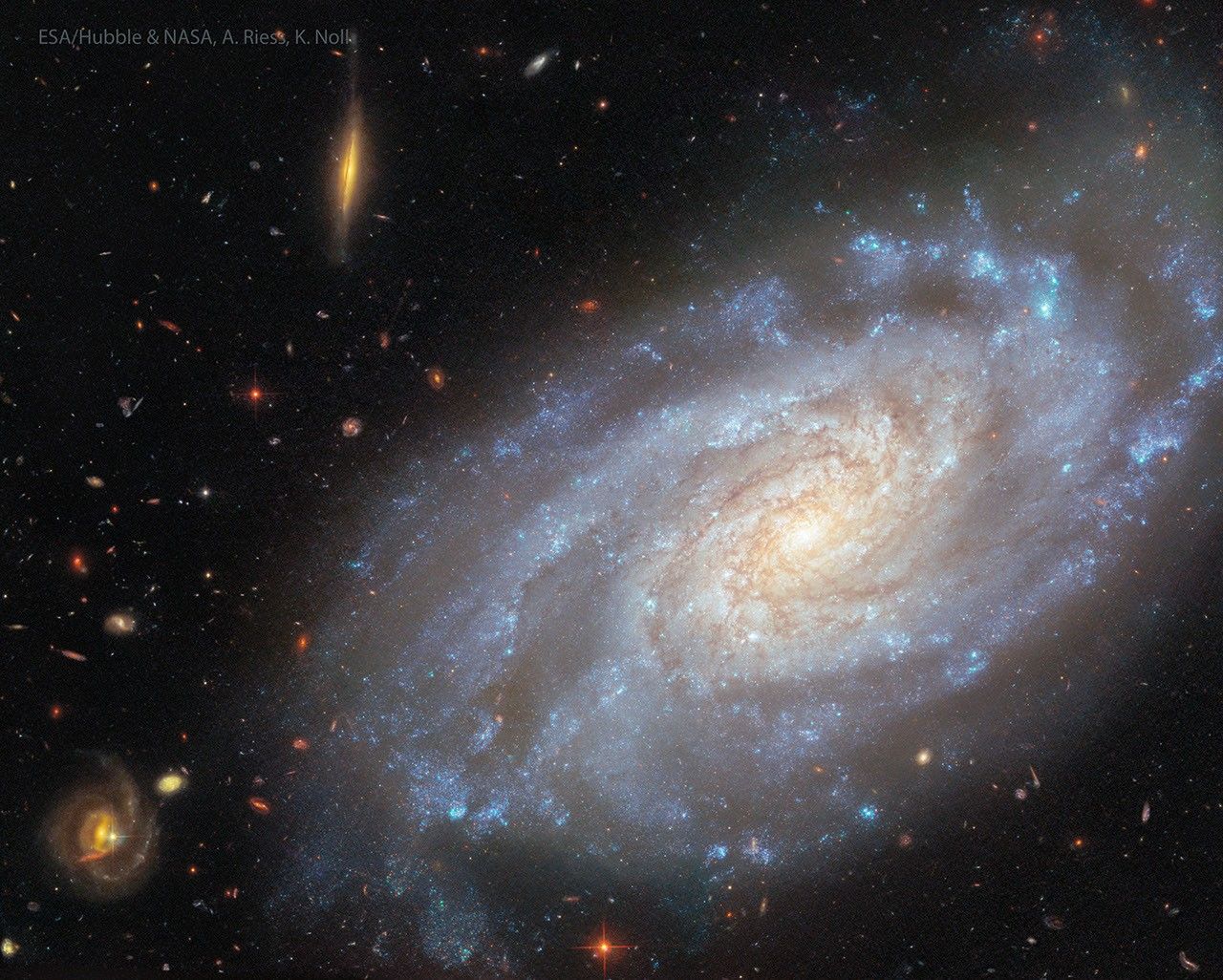
Is this what our own Milky Way Galaxy looks like from far away? Similar in size and grand design to our home Galaxy (although without the central bar), spiral galaxy NGC 3370 lies about 100 million light-years away toward the constellation of the Lion (Leo).
Recorded here in exquisite detail by the Hubble Space Telescope, the big, beautiful face-on spiral is not only photogenic, but has proven sharp enough to study individual stars known as Cepheids. These pulsating stars have been used to accurately determine NGC 3370's distance. NGC 3370 was chosen for this study because in 1994 the spiral galaxy was also home to a well studied stellar explosion -- a Type Ia supernova.
Combining the known distance to this standard candle supernova, based on the Cepheid measurements, with observations of supernovas at even greater distances has helped to reveal the size and expansion rate of the entire Universe itself.
Text from NASA APOD.
How to see it yourself
NGC 3370 — galaxy in the constellation Leo.
- Best seen in February – April, when it stands highest around midnight.
- From New York it climbs to 67° above the horizon. Visible from latitudes -63° to 90°.
- A very faint object: it takes a large telescope or astrophotography.
- Constellation
- Leo
- Magnitude
- 12,2m
- Apparent size
- 2,4′ arcminutes
Whether NGC 3370 is up for you tonight, and how the clouds and the Moon look — AstroTools shows it.