The Double Cluster in Perseus
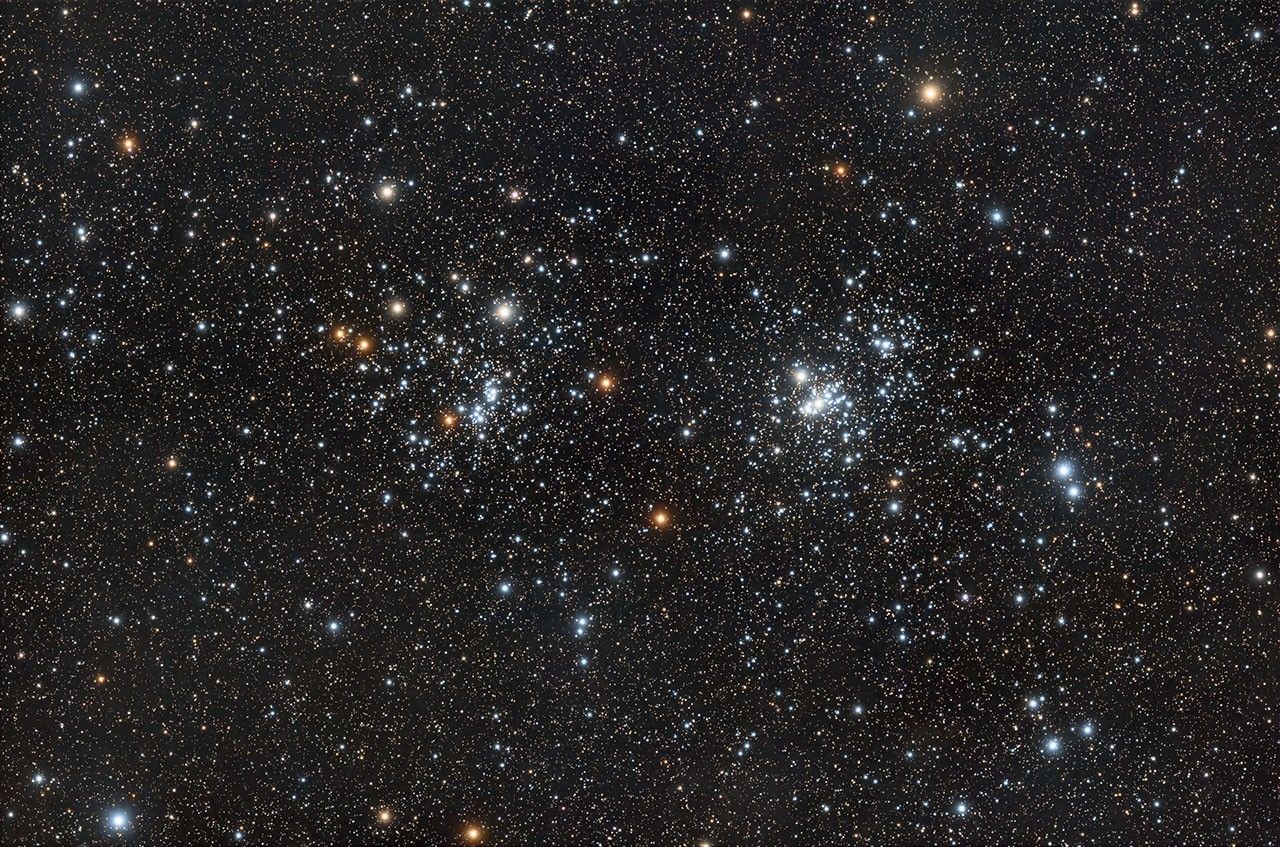
This stunning starfield spans about three full moons (1.5 degrees) across the heroic northern constellation of Perseus. It holds the famous pair of open star clusters, h and Chi Persei. Also cataloged as NGC 869 (right) and NGC 884, both clusters are about 7,000 light-years away and contain stars much younger and hotter than the Sun.
Separated by only a few hundred light-years, the clusters are both 13 million years young based on the ages of their individual stars, evidence that both clusters were likely a product of the same star-forming region. Always a rewarding sight in binoculars or small telescopes, the Double Cluster is even visible to the unaided eye from dark locations.
Text from NASA APOD.
How to see it yourself
h Persei Cluster (NGC 869) — open star cluster in the constellation Perseus.
- Best seen in September – November, when it stands highest around midnight.
- From New York it never sets and climbs to 74°. Visible from latitudes -23° to 90°.
- Visible to the naked eye under a dark sky away from city lights.
- Constellation
- Perseus
- Magnitude
- 3,7m
- Apparent size
- 14,4′ arcminutes
Whether NGC 869 is up for you tonight, and how the clouds and the Moon look — AstroTools shows it.