Trifid Pillars and Jets
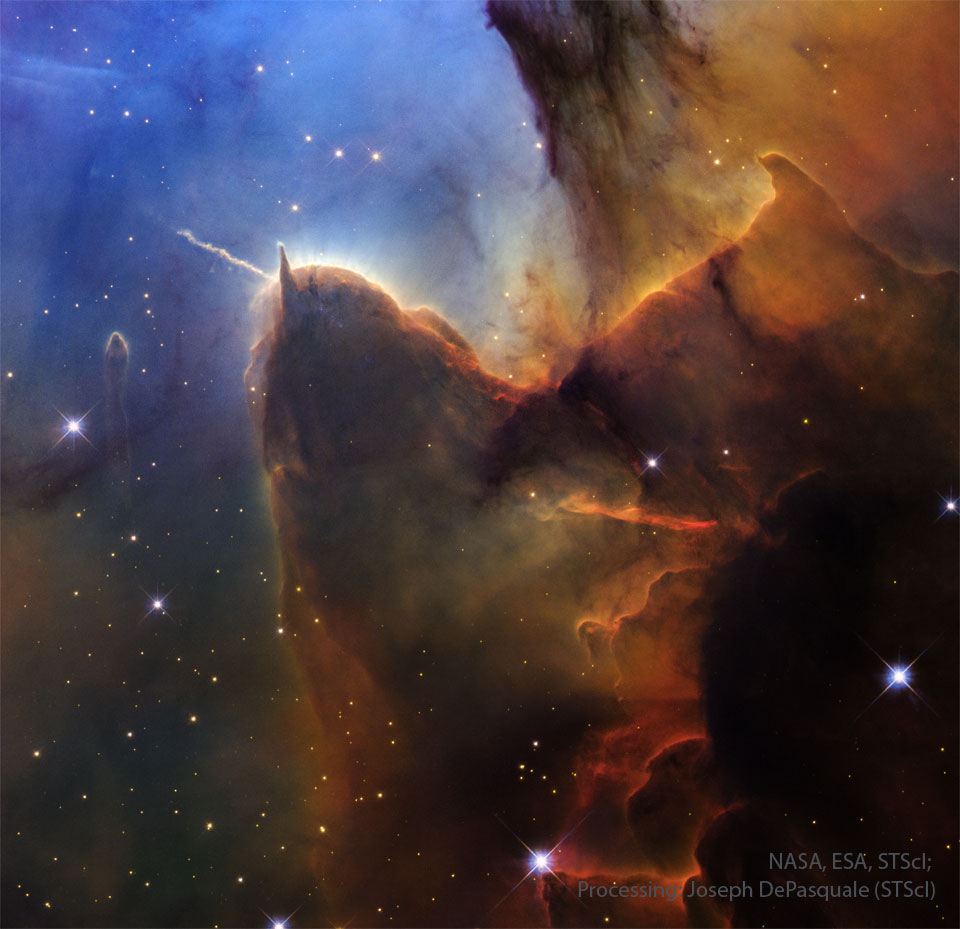
Dust pillars are like interstellar mountains.
They survive because they are more dense than their surroundings, but they are slowly being eroded away by a hostile environment.
Visible in the featured picture by the Hubble Space Telescope is the end of a huge gas and dust pillar in the Trifid Nebula (M20), punctuated by a smaller pillar pointing up and an unusual jet pointing to the upper left.
Many of the bright dots are newly formed stars. A star near the small pillar's end is slowly being stripped of its accreting gas by radiation from a tremendously brighter star situated off the top of the image.
The jet extends nearly a light-year and would not be visible without external illumination.
As gas and dust evaporate from the pillars, the hidden stellar source of this jet will likely be uncovered, possibly over the next 20,000 years.
Explore the Universe: Random APOD Generator
Text from NASA APOD.
How to see it yourself
Trifid Nebula (M20) — emission nebula in the constellation Sagittarius.
- Best seen in May – July, when it stands highest around midnight.
- From New York it climbs to 26° above the horizon. Visible from latitudes -90° to 57°.
- Needs a small telescope, 70–100 mm, and a sky free of light pollution. A UHC or OIII filter brings out its contrast.
- Constellation
- Sagittarius
- Magnitude
- 8,5m
- Apparent size
- 28′ arcminutes
Whether M20 is up for you tonight, and how the clouds and the Moon look — AstroTools shows it.