NGC 6946 and NGC 6939
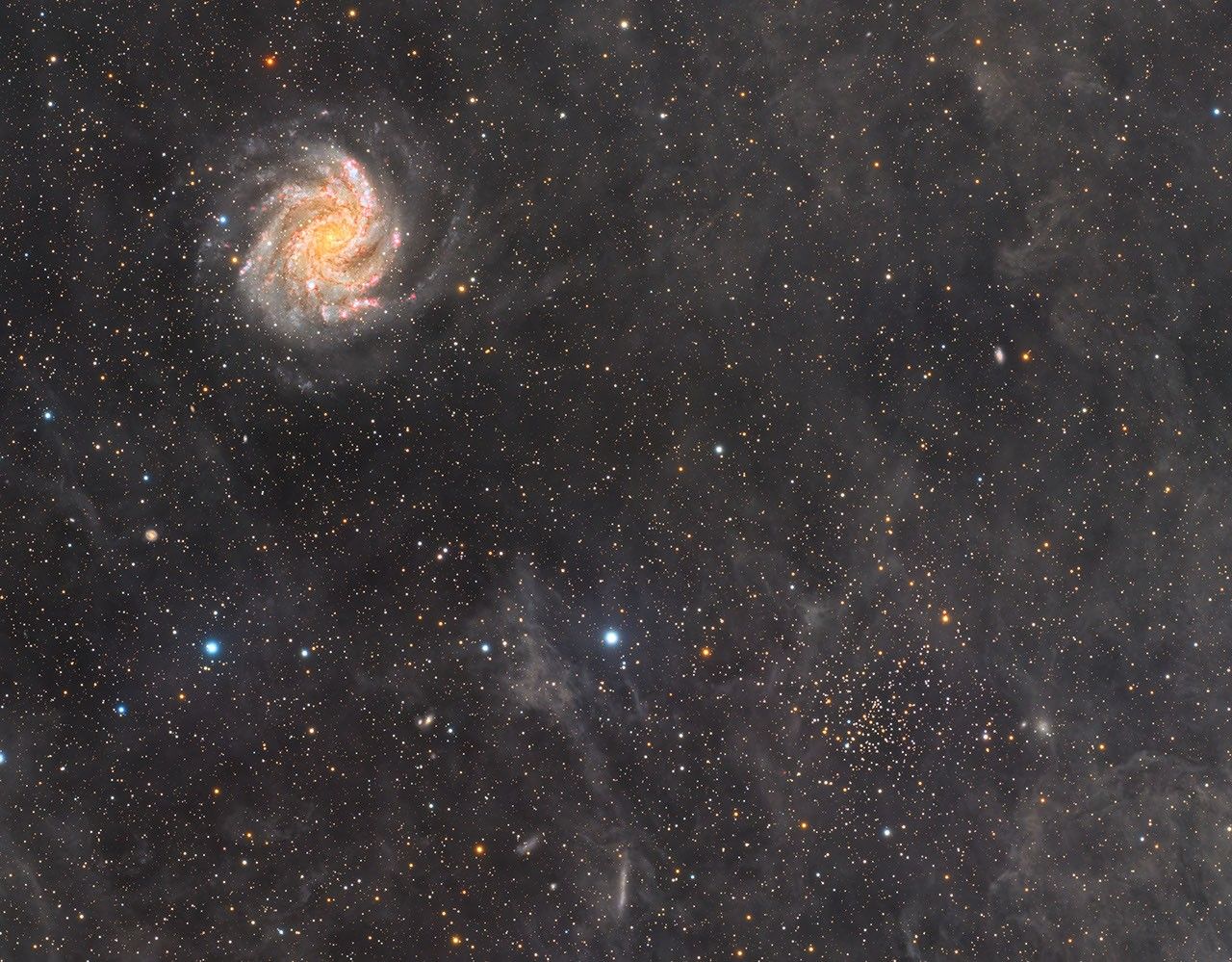
Face-on spiral galaxy NGC 6946 and open star cluster NGC 6939 share this cosmic snapshot, composed with over 68 hours of image data captured with a small telescope on planet Earth. The field of view spans spans about 1 degree or 2 full moons on the sky toward the northern constellation Cepheus. Seen through faint interstellar dust clouds near the plane of our Milky Way galaxy, the stars of open cluster NGC 6939 are 5,600 light-years in the distance, near bottom right in the frame. Face-on spiral galaxy NGC 6946 is at top left, but lies some 22 million light-years away. In the last 100 years, 10 supernovae have been discovered in NGC 6946, the latest one seen in 2017. By comparison, the average rate of supernovae in our Milky Way is about 1 every 100 years or so. Of course, NGC 6946 is also known as The Fireworks Galaxy.
Text from NASA APOD.
How to see it yourself
Fireworks Galaxy (NGC 6946) — galaxy in the constellation Cygnus.
- Best seen in June – August, when it stands highest around midnight.
- From New York it never sets and climbs to 71°. Visible from latitudes -20° to 90°.
- Needs a small telescope, 70–100 mm, and a sky free of light pollution.
- Constellation
- Cygnus
- Magnitude
- 9,1m
- Apparent size
- 11,4′ arcminutes
Whether NGC 6946 is up for you tonight, and how the clouds and the Moon look — AstroTools shows it.