NGC 4651: The Umbrella Galaxy
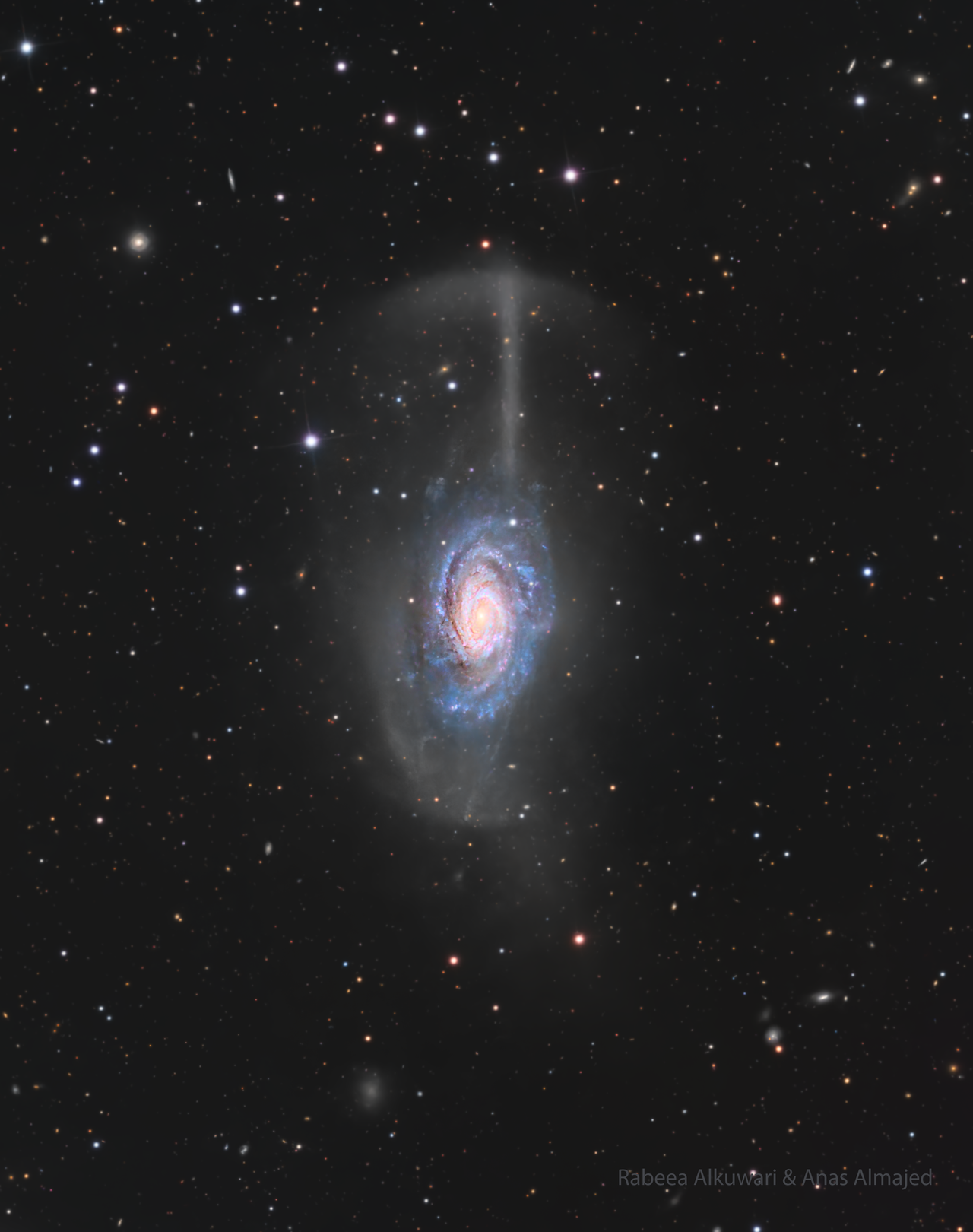
It's raining stars.
What appears to be a giant cosmic umbrella is now known to be a tidal stream of stars stripped from a small satellite galaxy. The main galaxy, spiral galaxy NGC 4651, is about the size of our Milky Way, while its stellar parasol appears to extend some 100 thousand light-years above this galaxy's bright disk. A small galaxy was likely torn apart by repeated encounters as it swept back and forth on eccentric orbits through NGC 4651. The remaining stars will surely fall back and become part of a combined larger galaxy over the next few million years. The featured deep image was captured in long exposures from Saudi Arabia. The Umbrella Galaxy lies about 50 million light-years distant toward the well-groomed northern constellation of Berenice's Hair (Coma Berenices).
APOD in a Modern Format StellarSnap
Text from NASA APOD.
How to see it yourself
Umbrella Galaxy (NGC 4651) — galaxy in the constellation Coma Berenices.
- Best seen in March – May, when it stands highest around midnight.
- From New York it climbs to 66° above the horizon. Visible from latitudes -64° to 90°.
- Needs a 150–200 mm telescope and a dark sky outside the city.
- Constellation
- Coma Berenices
- Magnitude
- 10,8m
- Apparent size
- 3,9′ arcminutes
Whether NGC 4651 is up for you tonight, and how the clouds and the Moon look — AstroTools shows it.