Messier 109
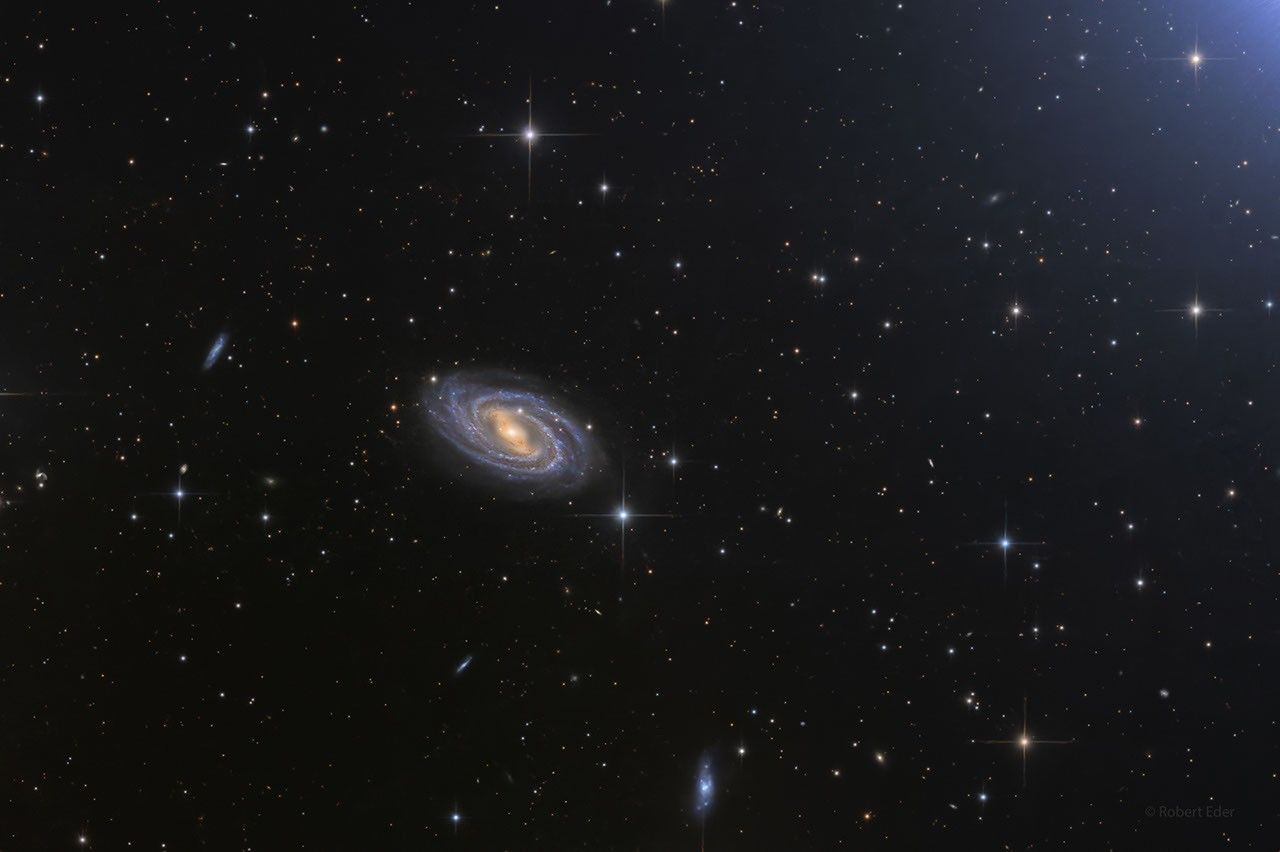
Big beautiful barred spiral galaxy Messier 109 is the 109th entry in Charles Messier's famous catalog of bright Nebulae and Star Clusters. You can find it just below the Big Dipper's bowl in the northern constellation Ursa Major. In fact, bright dipper star Phecda, Gamma Ursa Majoris, produces the glare at the upper right corner of this telescopic frame. M109's prominent central bar gives the galaxy the appearance of the Greek letter "theta", θ, a common mathematical symbol representing an angle. M109 spans a very small angle in planet Earth's sky though, about 7 arcminutes or 0.12 degrees. But that small angle corresponds to an enormous 120,000 light-year diameter at the galaxy's estimated 60 million light-year distance. The brightest member of the now recognized Ursa Major galaxy cluster, M109 (aka NGC 3992) is joined by spiky foreground stars. Three small, fuzzy bluish galaxies also on the scene, identified (top to bottom) as UGC 6969, UGC 6940 and UGC 6923, are possibly satellite galaxies of the larger barred spiral galaxy Messier 109.
Text from NASA APOD.
How to see it yourself
M109 — galaxy in the constellation Ursa Major.
- Best seen in February – April, when it stands highest around midnight.
- From New York it never sets and climbs to 77°. Visible from latitudes -27° to 90°.
- Needs a 150–200 mm telescope and a dark sky outside the city.
- Constellation
- Ursa Major
- Magnitude
- 9,9m
- Apparent size
- 8,1′ arcminutes
Whether M109 is up for you tonight, and how the clouds and the Moon look — AstroTools shows it.