Spiral Galaxy NGC 2566 from Webb
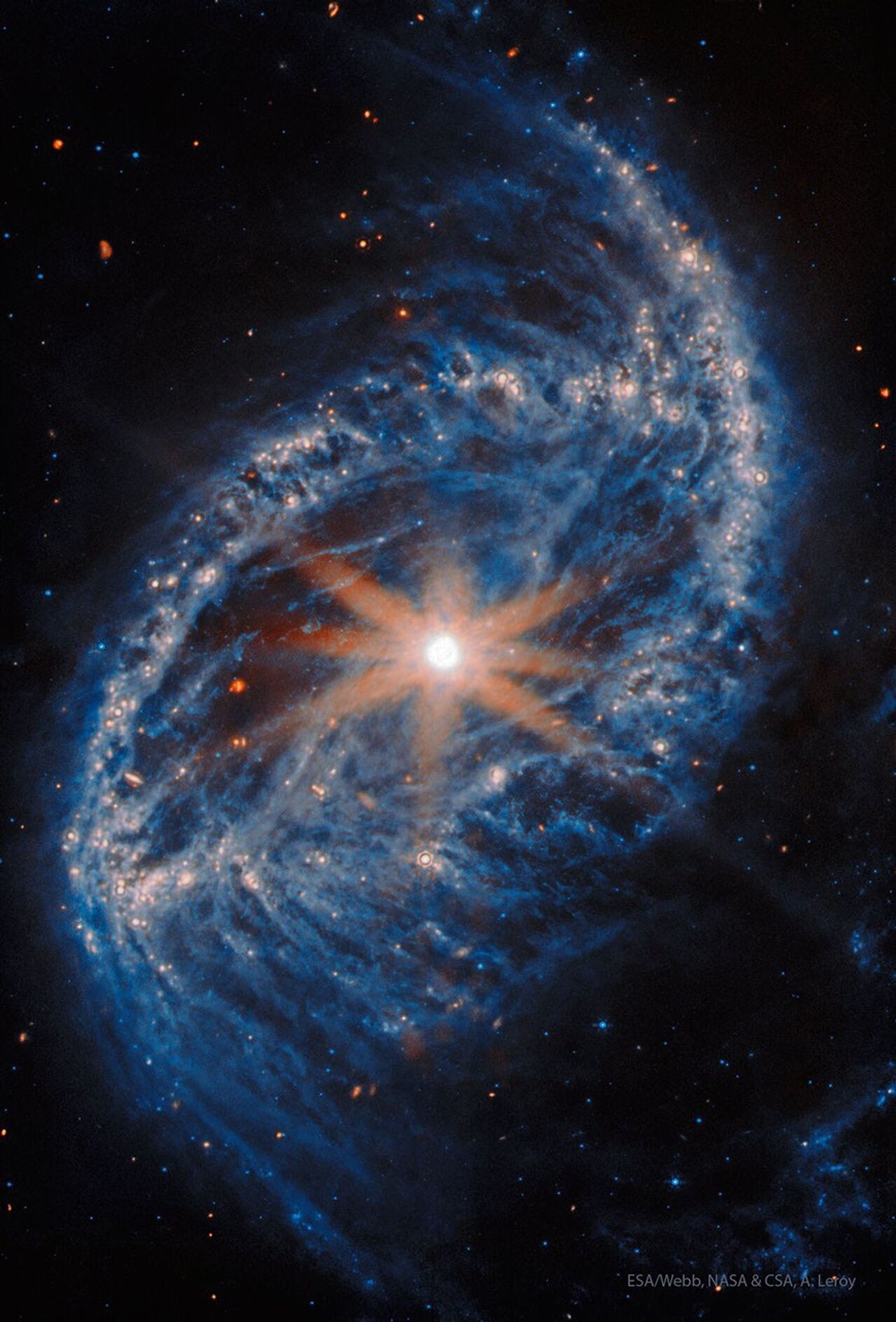
What’s happening in the center of spiral galaxy NGC 2566? First, the eight rays that appear to be coming out of the center in the featured infrared image are not real — they are diffraction spikes caused by the mechanical structure of the Webb space telescope itself. The center of NGC 2566 is bright but not considered unusual, which means that it likely contains a supermassive black hole, although currently not very active. At only 76 million light years away, the light we see from NGC 2566 today left when dinosaurs roamed the Earth. The picturesque galaxy is close enough so that Earthly telescopes, including Webb and Hubble, can resolve the turbulent clouds of gas and dust where stars can form and so allows study of stellar evolution. NGC 2566, similar in size to our Milky Way Galaxy, is notable for its bright central bar and its prominent outer spiral arms.
Text from NASA APOD.
How to see it yourself
NGC 2566 — galaxy in the constellation Puppis.
- Best seen in December – February, when it stands highest around midnight.
- From New York it climbs to 24° above the horizon. Visible from latitudes -90° to 55°.
- Needs a 150–200 mm telescope and a dark sky outside the city.
- Constellation
- Puppis
- Magnitude
- 10,8m
- Apparent size
- 4′ arcminutes
Whether NGC 2566 is up for you tonight, and how the clouds and the Moon look — AstroTools shows it.