NGC 4414: A Flocculent Spiral Galaxy
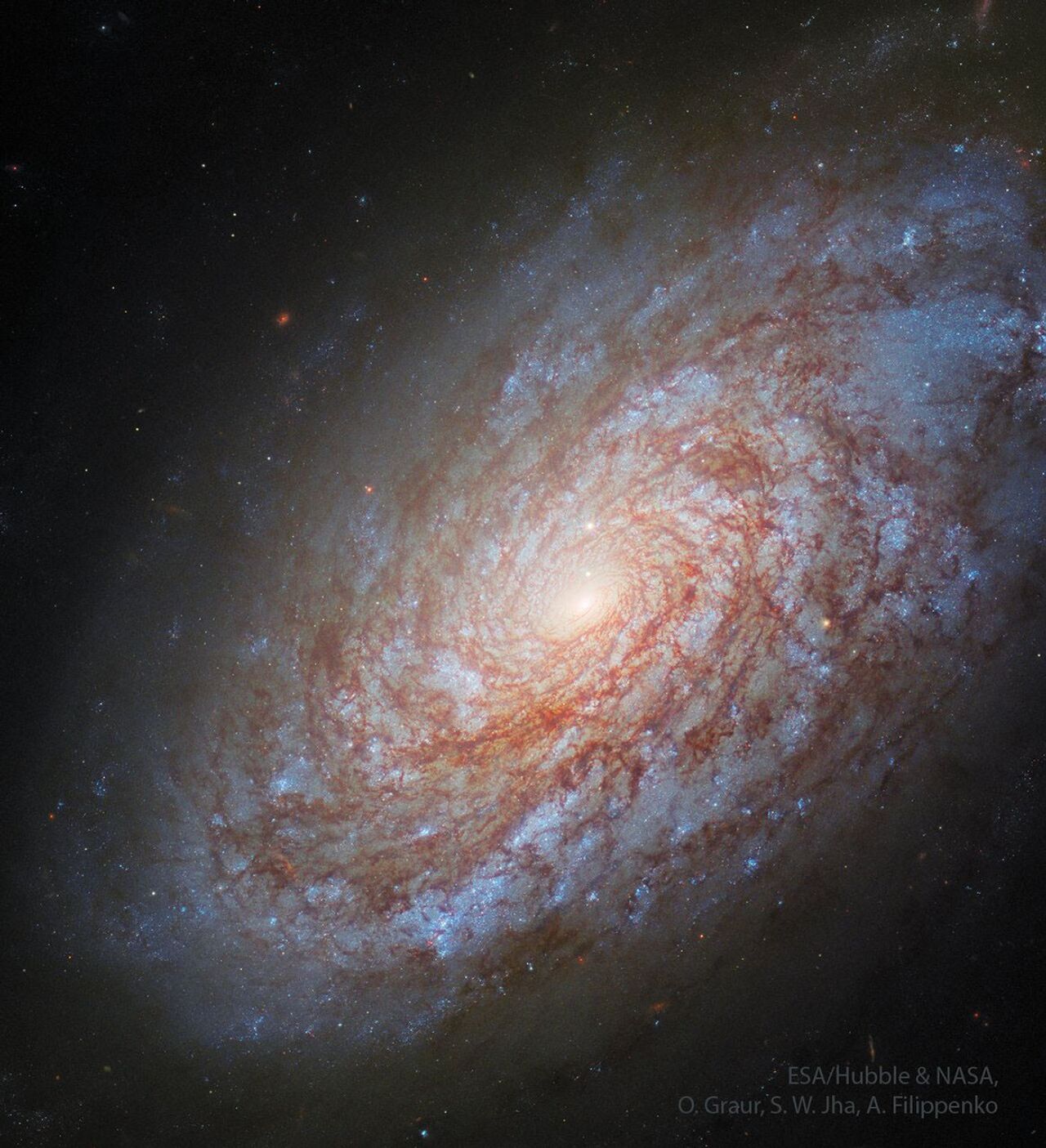
How much mass do flocculent spirals hide? The featured image of flocculent spiral galaxy NGC 4414 was taken with the Hubble Space Telescope to help answer this question. Flocculent spirals — galaxies without well-defined spiral arms — are a quite common form of galaxy, and NGC 4414 is one of the closest. Stars and gas near the visible edge of spiral galaxies orbit the center so fast that the gravity from a large amount of unseen dark matter must be present to hold them together. Understanding the matter and dark matter distribution of NGC 4414 helps humanity calibrate the rest of the galaxy and, by deduction, flocculent spirals in general. Further, calibrating the distance to NGC 4414 helps humanity calibrate the cosmological distance scale of the entire visible universe .
Text from NASA APOD.
How to see it yourself
NGC 4414 — galaxy in the constellation Coma Berenices.
- Best seen in February – April, when it stands highest around midnight.
- From New York it climbs to 81° above the horizon. Visible from latitudes -49° to 90°.
- Needs a 150–200 mm telescope and a dark sky outside the city.
- Constellation
- Coma Berenices
- Magnitude
- 10,2m
- Apparent size
- 2′ arcminutes
Whether NGC 4414 is up for you tonight, and how the clouds and the Moon look — AstroTools shows it.