Thor’s Helmet versus the Seagull
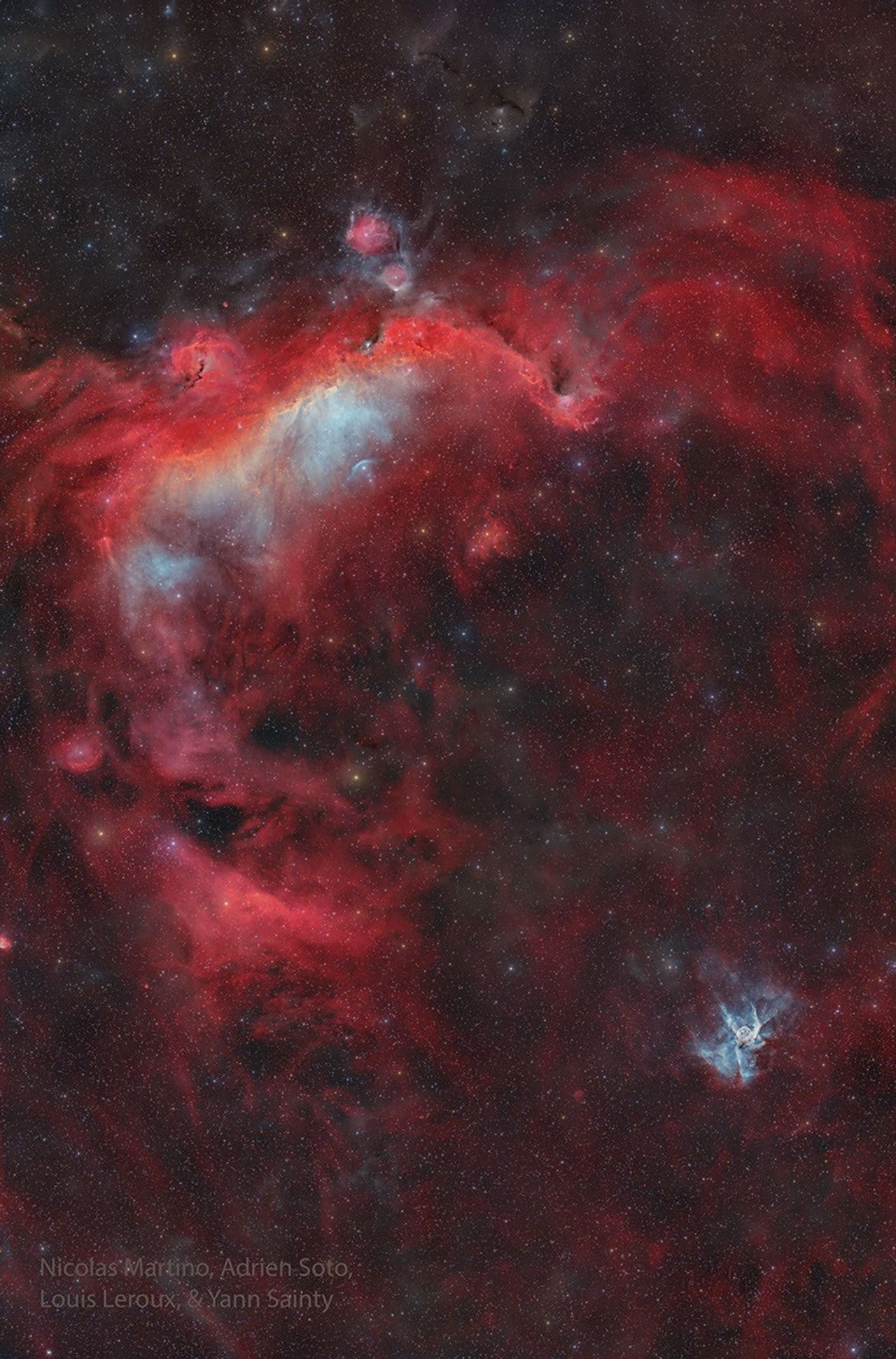
Seen as a seagull and a duck, these nebulae are not the only cosmic clouds to evoke images of flight. But both are winging their way across this broad celestial landscape, spanning almost 7 degrees across planet Earth ‘s night sky toward the constellation of the Big Dog ( Canis Major ). The expansive Seagull (top center) is itself composed of two major cataloged emission nebulas . Brighter NGC 2327 forms the head with the more diffuse IC 2177 as the wings and body. Impressively, the Seagull’s wingspan would correspond to about 250 light-year s at the nebula’s estimated distance of 3,800 light-years. At the lower right, the Duck appears much more compact and would span only about 50 light-years given its 15,000 light-year distance estimate. Blown by energetic winds from an extremely massive, hot star near its center, the Duck nebula is cataloged as NGC 2359. Of course, the Duck’s thick body and winged appendages also lend it the slightly more dramatic popular moniker, Thor’s Helmet . Portal Universe: Random APOD Generator
Text from NASA APOD.
How to see it yourself
NGC 232 — galaxy in the constellation Cetus.
- Best seen in August – October, when it stands highest around midnight.
- From New York it climbs to 26° above the horizon. Visible from latitudes -90° to 56°.
- A very faint object: it takes a large telescope or astrophotography.
- Constellation
- Cetus
- Magnitude
- 14,5m
- Apparent size
- 1′ arcminutes
Whether NGC 232 is up for you tonight, and how the clouds and the Moon look — AstroTools shows it.