IC 2574: Coddington’s Nebula
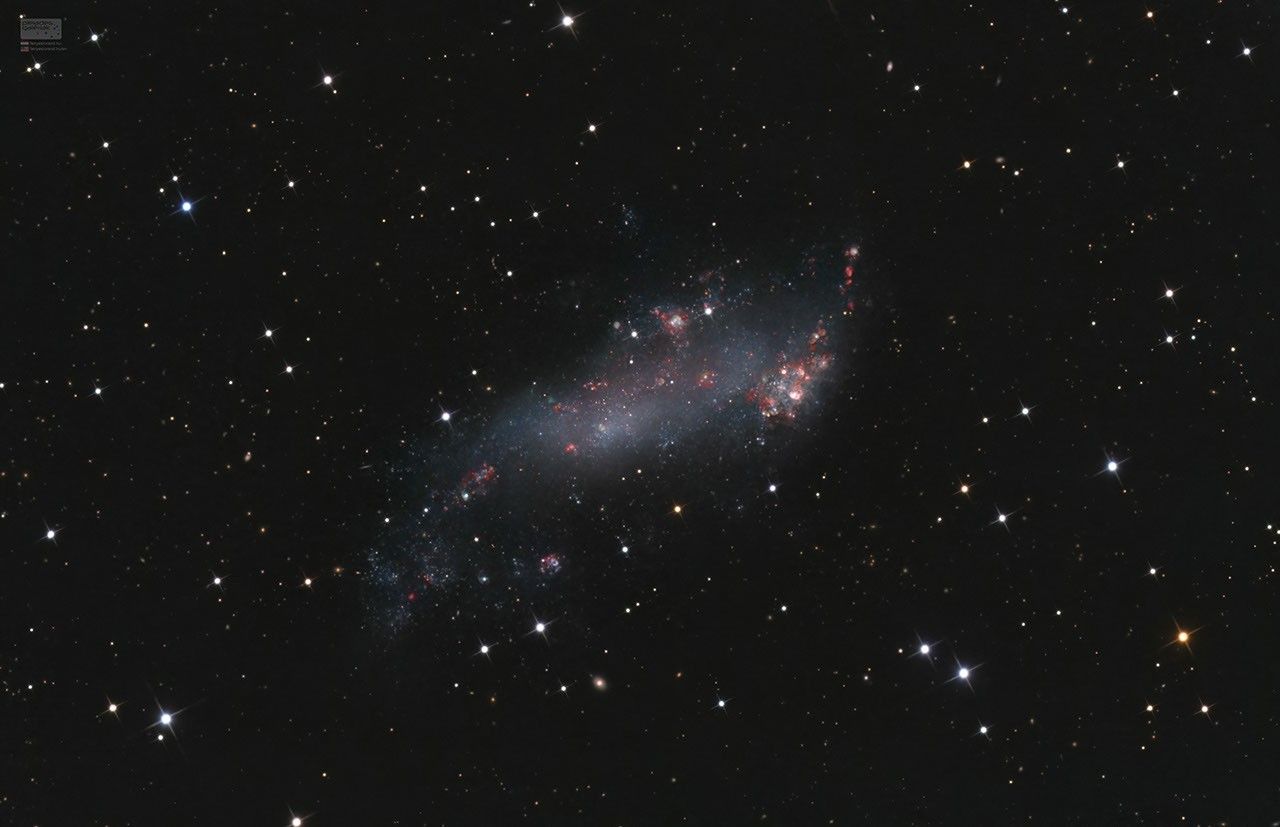
Grand spiral galaxies often seem to get all the glory, flaunting their young, bright, blue star clusters in beautiful, symmetric spiral arms. But small, irregular galaxies form stars too. In fact dwarf galaxy IC 2574 shows clear evidence of intense star forming activity in its telltale reddish regions of glowing hydrogen gas. Just as in spiral galaxies, the turbulent star-forming regions in IC 2574 are churned by stellar winds and supernova explosions spewing material into the galaxy’s interstellar medium and triggering further star formation. A mere 12 million light-years distant, IC 2574 is part of the M81 group of galaxies, seen toward the northern constellation Ursa Major. Also known as Coddington’s Nebula, the lovely island universe is about 50,000 light-years across, discovered by American astronomer Edwin Coddington in 1898.
Text from NASA APOD.
How to see it yourself
Coddington's Nebula (IC 2574) — galaxy in the constellation Ursa Major.
- Best seen in January – March, when it stands highest around midnight.
- From New York it never sets and climbs to 62°. Visible from latitudes -12° to 90°.
- Needs a 150–200 mm telescope and a dark sky outside the city.
- Constellation
- Ursa Major
- Magnitude
- 10,5m
- Apparent size
- 12,9′ arcminutes
Whether IC 2574 is up for you tonight, and how the clouds and the Moon look — AstroTools shows it.