The Variable Nebula NGC 2261
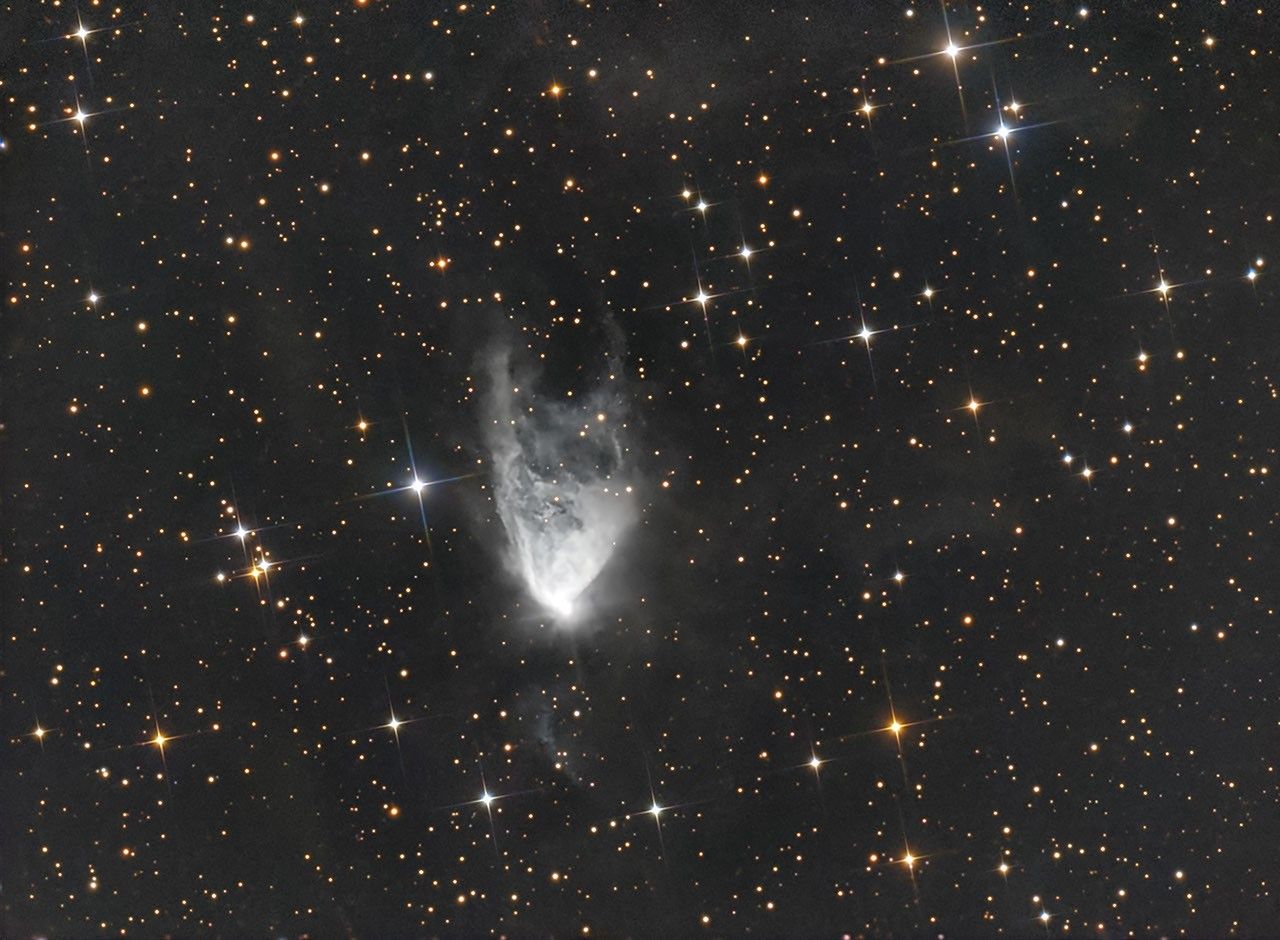
The interstellar cloud of dust and gas captured in this sharp telescopic snapshot is seen to change its appearance noticeably over periods as short as a few weeks. Discovered over 200 years ago and cataloged as NGC 2261, bright star R Monocerotis lies at the tip of the fan-shaped nebula. About one light-year across and 2500 light-years away, NGC 2261 was studied early last century by astronomer Edwin Hubble and the mysterious cosmic cloud is now more famous as Hubble’s Variable Nebula. So what makes Hubble’s nebula vary? NGC 2261 is composed of a dusty reflection nebula fanning out from the star R Monocerotis . The leading variability explanation holds that dense knots of obscuring dust pass close to R Mon and cast moving shadows across the dust clouds in the rest of Hubble’s Variable Nebula .
Text from NASA APOD.
How to see it yourself
Hubble's Nebula (NGC 2261) — reflection nebula in the constellation Monoceros.
- Best seen in November – January, when it stands highest around midnight.
- From New York it climbs to 58° above the horizon. Visible from latitudes -71° to 89°.
- Needs a 150–200 mm telescope and a dark sky outside the city.
- Constellation
- Monoceros
- Magnitude
- 11,9m
- Apparent size
- 2′ arcminutes
Whether NGC 2261 is up for you tonight, and how the clouds and the Moon look — AstroTools shows it.