Rigel and the Witch Head Nebula
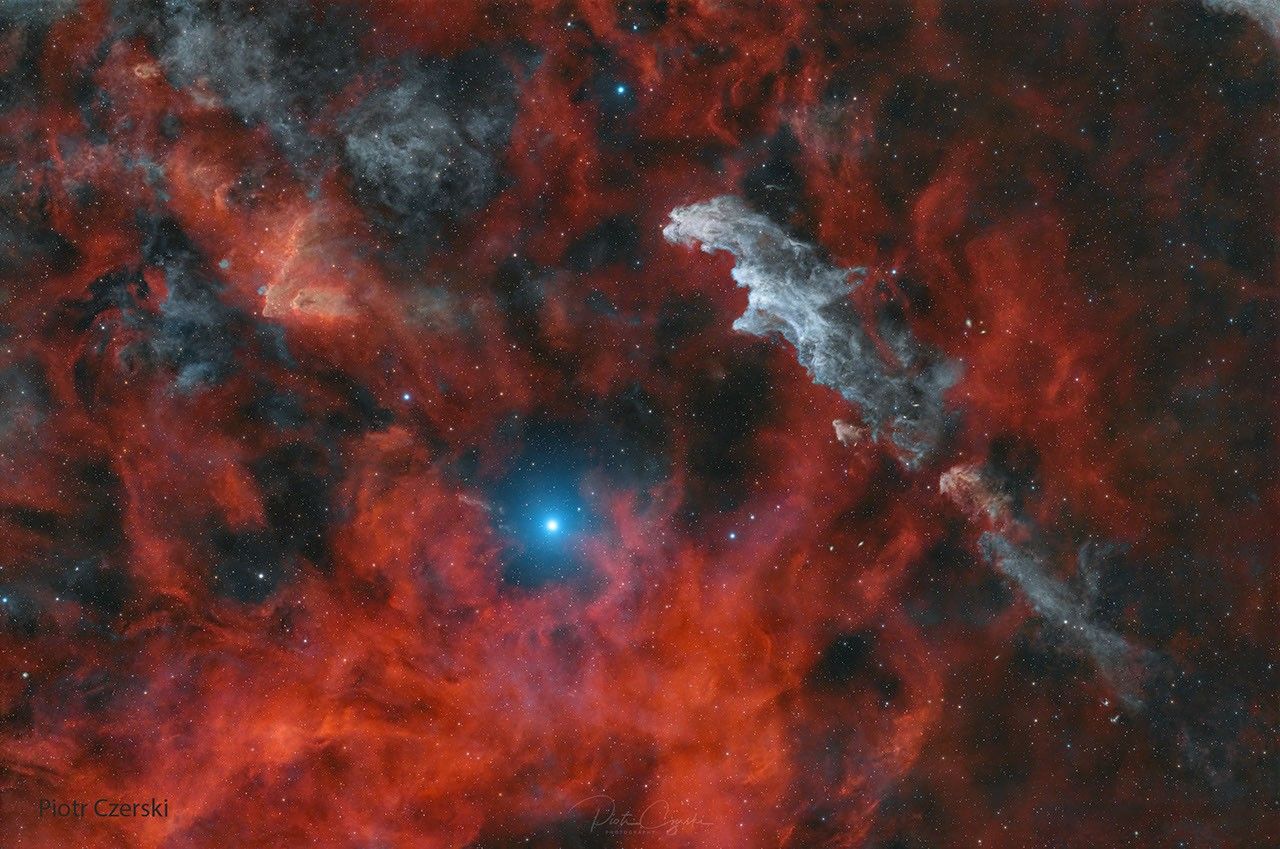
Does the blue nebula look like the head of a witch? The nebula is known popularly as the Witch Head Nebula because, it is said, the nebula’s shape resembles a Halloween-style caricature of a witch’s head. Exactly how, though, can be a topic of imaginative speculation. What is clear is that IC 2118 is about 50 light-years across and made of gas and dust that points to — because it has been partly eroded by — the nearby star Rigel. One of the brighter stars in the constellation Orion, Rigel lies just below the center of the featured image. The blue color of the Witch Head Nebula and is caused not only by Rigel’s intense blue starlight but also because the dust grains scatter blue light more efficiently than red. The same physical process causes Earth’s daytime sky to appear blue, although the scatterers in planet Earth’s atmosphere are molecules of nitrogen and oxygen.
Text from NASA APOD.
How to see it yourself
Witch Head Nebula (IC 2118) — reflection nebula in the constellation Eridanus.
- Best seen in November – January, when it stands highest around midnight.
- From New York it climbs to 42° above the horizon. Visible from latitudes -87° to 73°.
- Hardly visible to the eye — a target for long-exposure astrophotography.
- Constellation
- Eridanus
- Apparent size
- 180′ arcminutes
Whether IC 2118 is up for you tonight, and how the clouds and the Moon look — AstroTools shows it.