M78: Reflecting Blue in a Sea of Red
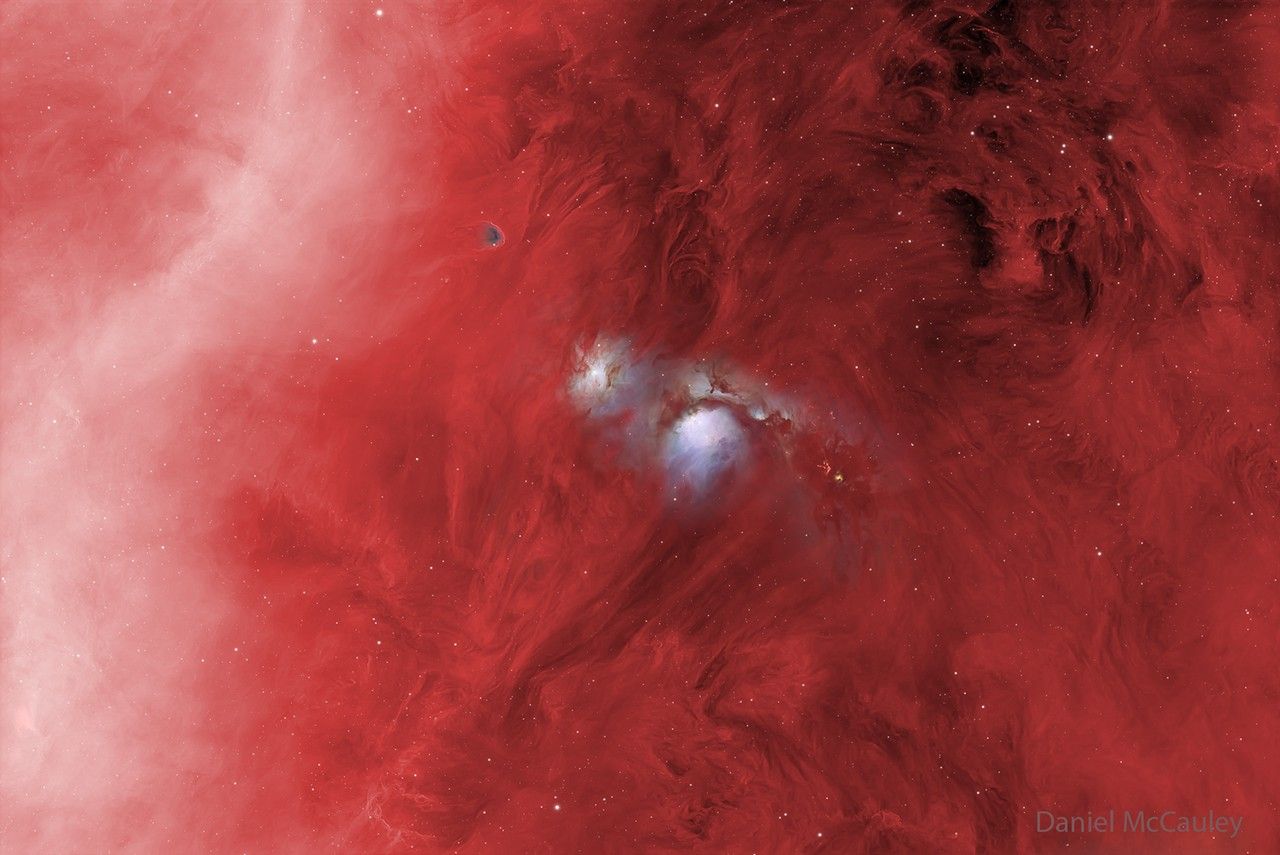
In the vast Orion Molecular Cloud complex, several bright blue nebulas are particularly apparent.
Pictured here in the center are two of the most prominent reflection nebulas - dust clouds lit by the reflecting light of bright embedded stars.
The more famous nebula is M78, in the image center, cataloged over 200 years ago.
To its upper left is the lesser known NGC 2071.
Astronomers continue to study these reflection nebulas to better understand how interior stars form.
The overall red glow is from diffuse hydrogen gas that covers much of the Orion complex that spans much of the constellation of Orion. Nearby in the greater complex, which lies about 1,500 light years away, are the Orion Nebula, the Horsehead Nebula, and Barnard's Loop -- partially seen here as the white band on the upper left.
Almost Hyperspace: Random APOD Generator
Text from NASA APOD.
How to see it yourself
M78 — reflection nebula in the constellation Orion.
- Best seen in November – January, when it stands highest around midnight.
- From New York it climbs to 49° above the horizon. Visible from latitudes -80° to 80°.
- Needs a small telescope, 70–100 mm, and a sky free of light pollution.
- Constellation
- Orion
- Magnitude
- 8,0m
- Apparent size
- 4,5′ arcminutes
Whether M78 is up for you tonight, and how the clouds and the Moon look — AstroTools shows it.