Colliding Spiral Galaxies from Webb and Hubble
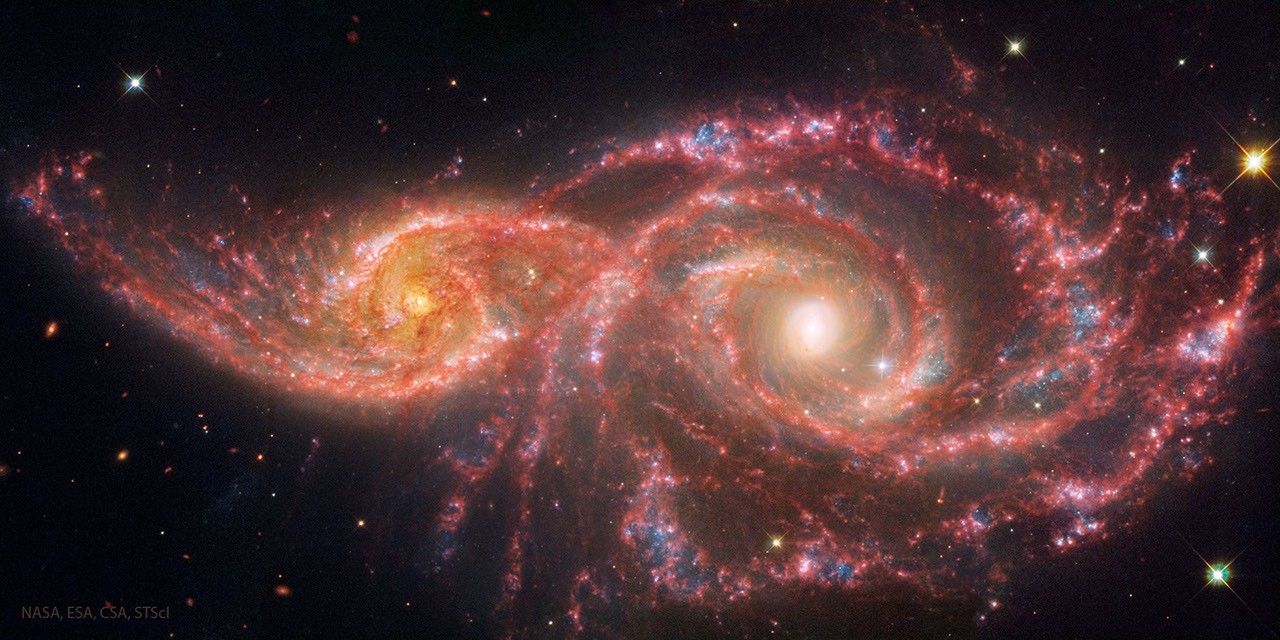
Billions of years from now, only one of these two galaxies will remain. Until then, spiral galaxies NGC 2207 and IC 2163 will slowly pull each other apart, creating tides of matter, sheets of shocked gas , lanes of dark dust , bursts of star formation , and streams of cast-away stars . The featured image in scientifically assigned colors is a composite of Hubble exposures in visible light and Webb exposures in infrared light. Astronomers predict that NGC 2207, the larger galaxy on the right, will eventually incorporate IC 2163, the smaller galaxy on the left. In the most recent encounter that about peaked 40 million years ago, the smaller galaxy is swinging around counter-clockwise and is now slightly behind the larger galaxy. The space between stars is so vast that when galaxies collide , the stars in them usually do not collide. Jigsaw Challenge: Astronomy Puzzle of the Day
Text from NASA APOD.
How to see it yourself
NGC 2207 — galaxy in the constellation Canis Major.
- Best seen in November – January, when it stands highest around midnight.
- From New York it climbs to 28° above the horizon. Visible from latitudes -90° to 59°.
- Needs a 150–200 mm telescope and a dark sky outside the city.
- Constellation
- Canis Major
- Magnitude
- 11,1m
- Apparent size
- 4,9′ arcminutes
Whether NGC 2207 is up for you tonight, and how the clouds and the Moon look — AstroTools shows it.