NGC 7635: The Bubble Nebula
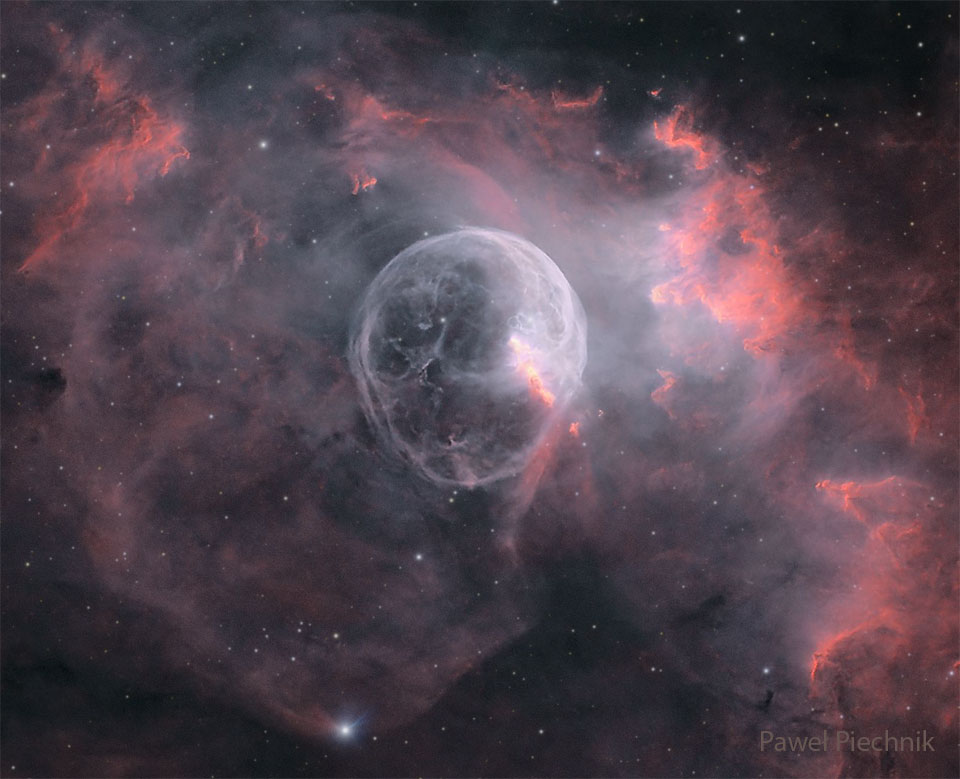
What created this huge space bubble? Blown by the wind from a star, this tantalizing, head-like apparition is cataloged as NGC 7635, but known simply as the Bubble Nebula. Taken from Krakow, Poland, the featured view utilizes a long exposure to reveal the intricate details of this cosmic bubble and its environment. Although it looks delicate, the 10 light-year diameter bubble offers evidence of violent processes at work. Seen here right of the Bubble's center, a bright hot star is embedded in the nebula's reflecting dust. A fierce stellar wind and intense radiation from the star, which likely has a mass 10 to 20 times that of the Sun, has blasted out the structure of glowing gas against denser material in a surrounding molecular cloud. The intriguing Bubble Nebula lies a mere 11,000 light-years away toward the boastful constellation Cassiopeia.
Text from NASA APOD.
How to see it yourself
Bubble Nebula (NGC 7635) — emission nebula in the constellation Cassiopeia.
- Best seen in August – October, when it stands highest around midnight.
- From New York it never sets and climbs to 69°. Visible from latitudes -19° to 90°.
- Needs a 150–200 mm telescope and a dark sky outside the city. A UHC or OIII filter brings out its contrast.
- Constellation
- Cassiopeia
- Magnitude
- 11,0m
- Apparent size
- 15′ arcminutes
Whether NGC 7635 is up for you tonight, and how the clouds and the Moon look — AstroTools shows it.