The Claw and Bubble Nebulae
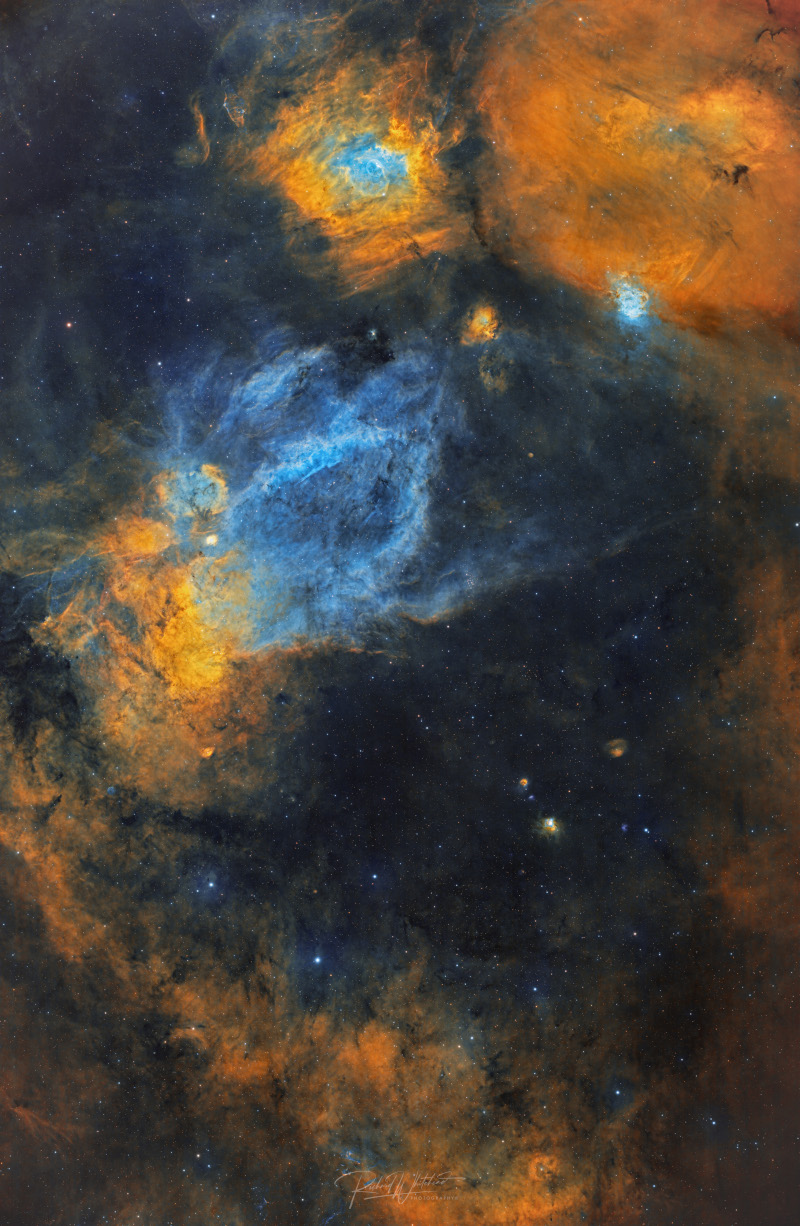
What unexpected things do you see when you look up at the night sky? Today’s image resembles an abstract painting, with large swaths of color strewn across a cosmic canvas seemingly without design. Despite the image's abstract nature, the human mind finds patterns, identifying a large claw reaching up towards a floating bubble. Embedded within these seemingly random structures are the physical laws that govern how light and matter interact. The Claw (Sh2-157) and Bubble (NGC 7635) Nebulae glow colors that are mapped to the yellow and blue shown, indicating the presence of hydrogen and oxygen ionized by the intense light emitted from stars several times the mass of the Sun. This image depicts both the chaos and structure of astronomical processes, showing that a common thread between art and science is to look for the unexpected.
Text from NASA APOD.
How to see it yourself
Bubble Nebula (NGC 7635) — emission nebula in the constellation Cassiopeia.
- Best seen in August – October, when it stands highest around midnight.
- From New York it never sets and climbs to 69°. Visible from latitudes -19° to 90°.
- Needs a 150–200 mm telescope and a dark sky outside the city. A UHC or OIII filter brings out its contrast.
- Constellation
- Cassiopeia
- Magnitude
- 11,0m
- Apparent size
- 15′ arcminutes
Whether NGC 7635 is up for you tonight, and how the clouds and the Moon look — AstroTools shows it.