Thackeray's Globules
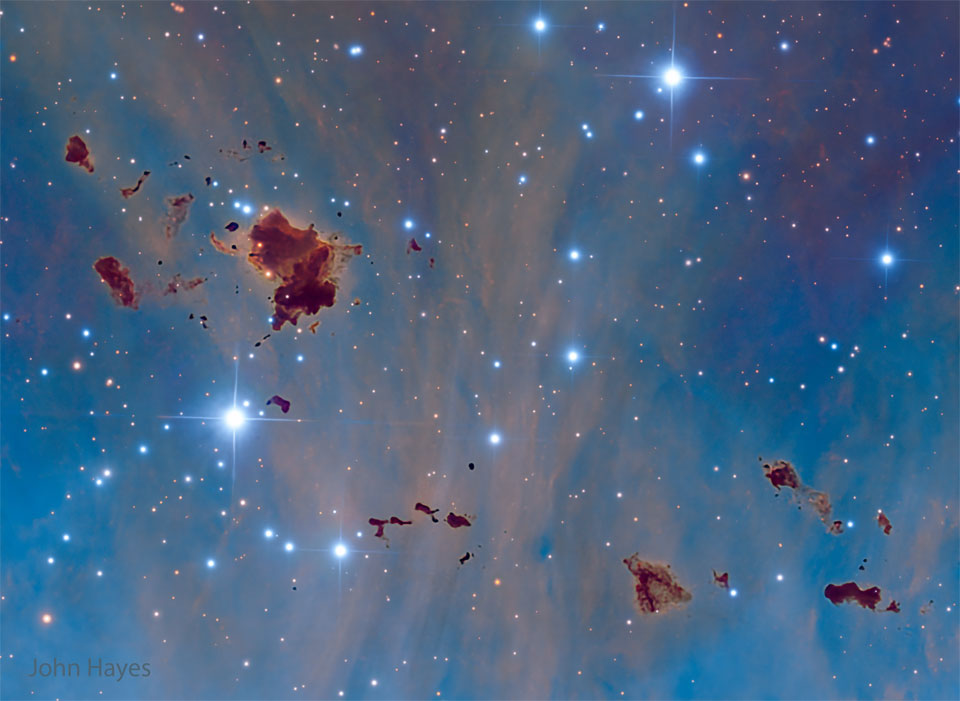
What are these strange space globs?
Situated in rich star fields and glowing hydrogen gas, these opaque clouds of interstellar dust and gas are so large they might be able to form stars. Their home is known as IC 2944, a bright stellar nursery located about 7,600 light years away toward the constellation of the Centaur (Centaurus). The largest of these dark globules, first spotted by A. D. Thackeray in 1950 using a telescope in South Africa, is likely two separate but overlapping clouds, each more than one light-year wide. Along with other data, the featured Hubble palette image from the El Sauce Observatory in Chile, indicates that Thackeray's globules are fractured and churning as a result of intense ultraviolet radiation from young, hot stars already energizing and heating the bright emission nebula. These and similar dark globules known to be associated with other star forming regions may ultimately be dissipated by their hostile environment -- like cosmic lumps of butter in a hot frying pan.
Interstellar Jigsaw: Astronomy Puzzle of the Day
Text from NASA APOD.
How to see it yourself
lam Cen Nebula (IC 2944) — emission nebula in the constellation Centaurus.
- Best seen in February – April, when it stands highest around midnight.
- From New York it never rises: you need to be further south. Visible from latitudes -90° to 17°.
- Visible to the naked eye under a dark sky away from city lights. A UHC or OIII filter brings out its contrast.
- Constellation
- Centaurus
- Magnitude
- 4,5m
- Apparent size
- 7,2′ arcminutes
Whether IC 2944 is up for you tonight, and how the clouds and the Moon look — AstroTools shows it.