The Horsehead Nebula
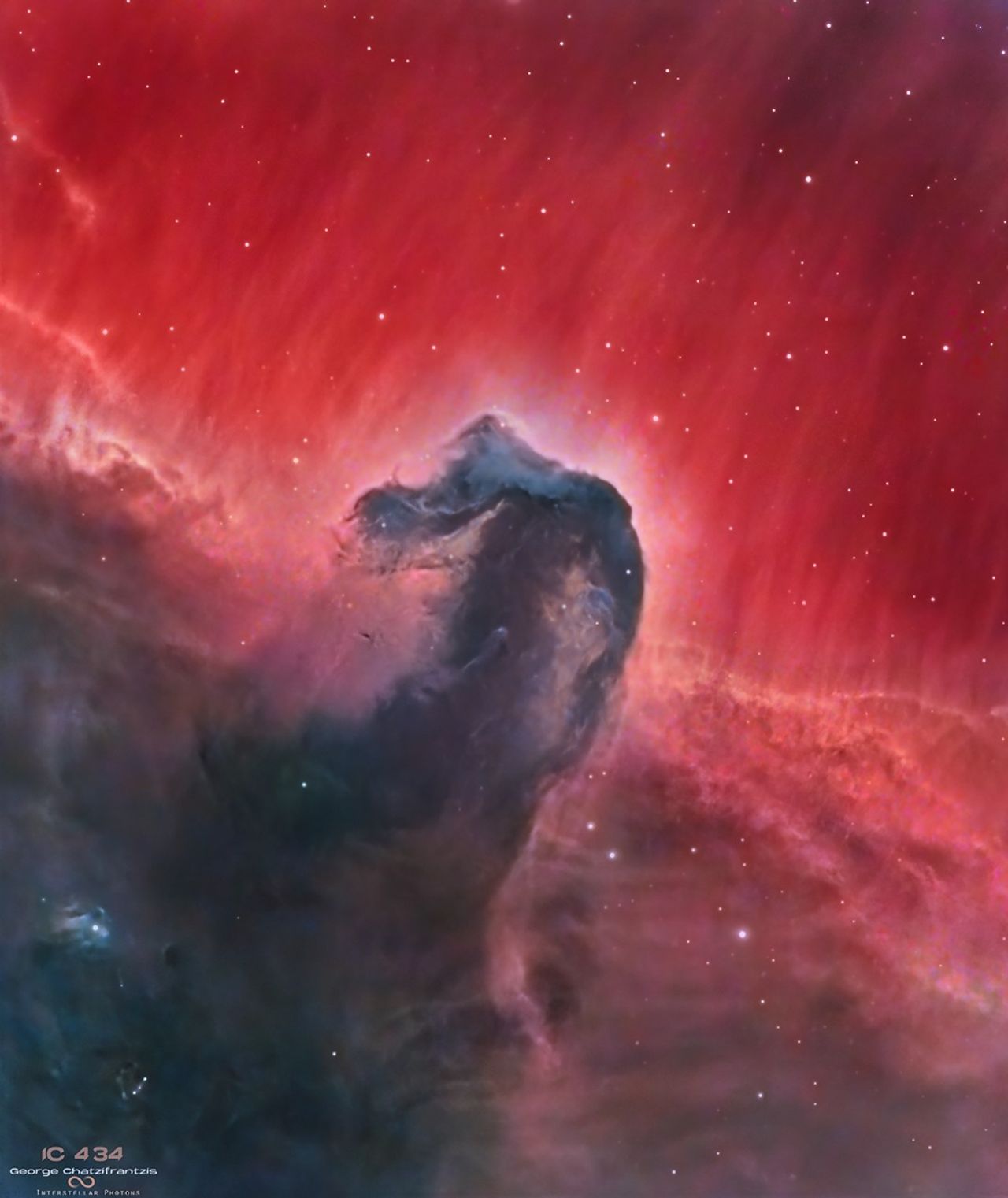
Sculpted by stellar winds and radiation, this dusty interstellar molecular cloud has by chance assumed an immediately recognizable shape. Fittingly known as The Horsehead Nebula, it lies some 1,500 light-years distant, embedded in the vast Orion cloud complex. About five light-years "tall," the dark cloud is cataloged as Barnard 33, first identified on a photographic plate taken in the early 20th century.
B33 is visible primarily because its obscuring dust is silhouetted against the glow of emission nebula IC 434.
Hubble Space Telescope images from the early 21st century find young stars forming within B33. Of course, the magnificent interstellar cloud will slowly shift its apparent shape over the next few million years. But for now the Horsehead Nebula is a rewarding though difficult object to view with small telescopes from planet Earth.
Text from NASA APOD.
How to see it yourself
Horsehead Nebula (B33) — dark nebula in the constellation Orion.
- Best seen in November – January, when it stands highest around midnight.
- From New York it climbs to 47° above the horizon. Visible from latitudes -82° to 78°.
- Hardly visible to the eye — a target for long-exposure astrophotography.
- Constellation
- Orion
- Apparent size
- 8′ arcminutes
Whether B33 is up for you tonight, and how the clouds and the Moon look — AstroTools shows it.