The Horsehead and Flame Nebulas
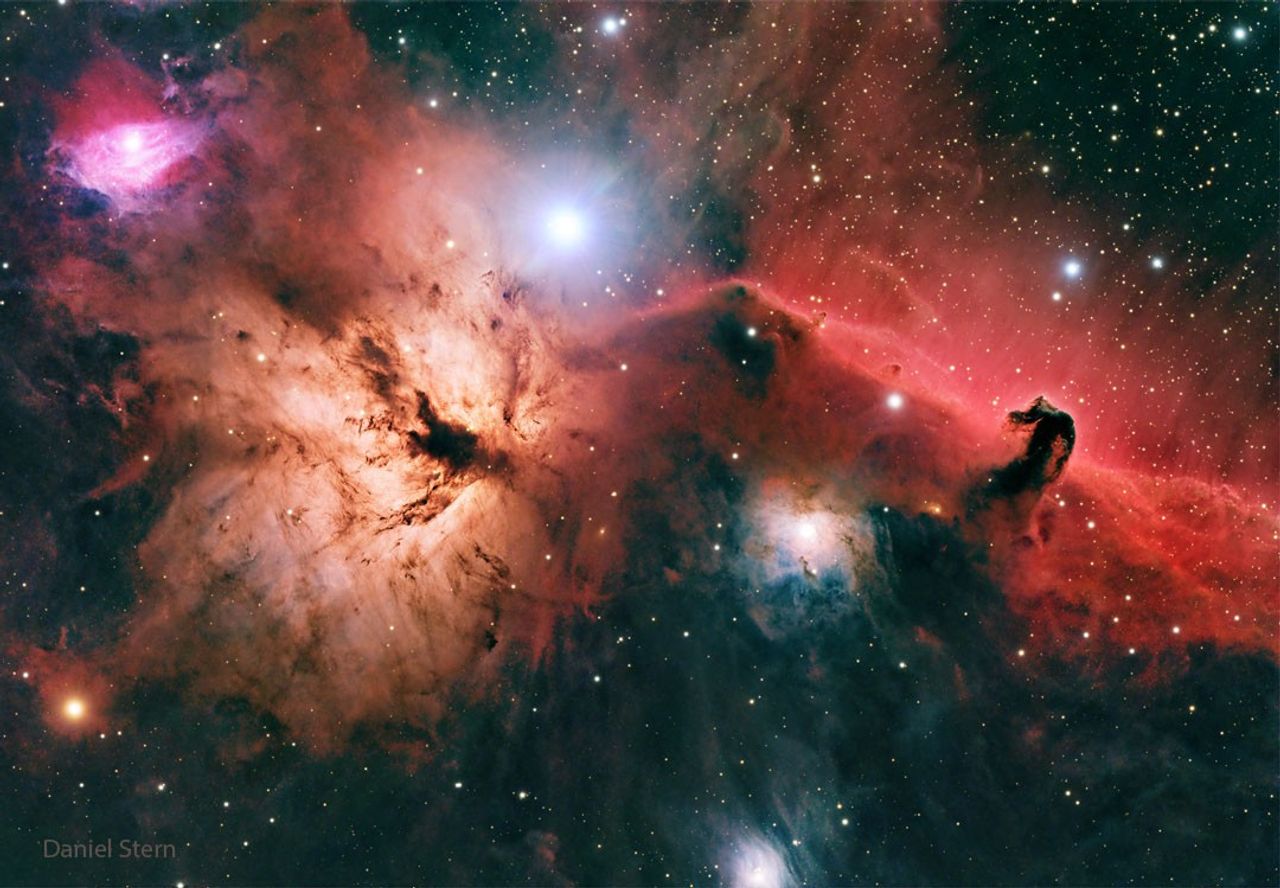
The Horsehead Nebula is one of the most famous nebulae on the sky.
It is visible as the dark indentation to the orange emission nebula at the far right of the featured picture.
The horse-head feature is dark because it is really an opaque dust cloud that lies in front of the bright emission nebula. Like clouds in Earth's atmosphere, this cosmic cloud has assumed a recognizable shape by chance.
After many thousands of years, the internal motions of the cloud will surely alter its appearance.
The emission nebula's orange color is caused by electrons recombining with protons to form hydrogen atoms.
Toward the lower left of the image is the Flame Nebula, an orange-tinged nebula that also contains intricate filaments of dark dust.
Text from NASA APOD.
How to see it yourself
Horsehead Nebula (B33) — dark nebula in the constellation Orion.
- Best seen in November – January, when it stands highest around midnight.
- From New York it climbs to 47° above the horizon. Visible from latitudes -82° to 78°.
- Hardly visible to the eye — a target for long-exposure astrophotography.
- Constellation
- Orion
- Apparent size
- 8′ arcminutes
Whether B33 is up for you tonight, and how the clouds and the Moon look — AstroTools shows it.