NGC 6888: The Crescent Nebula
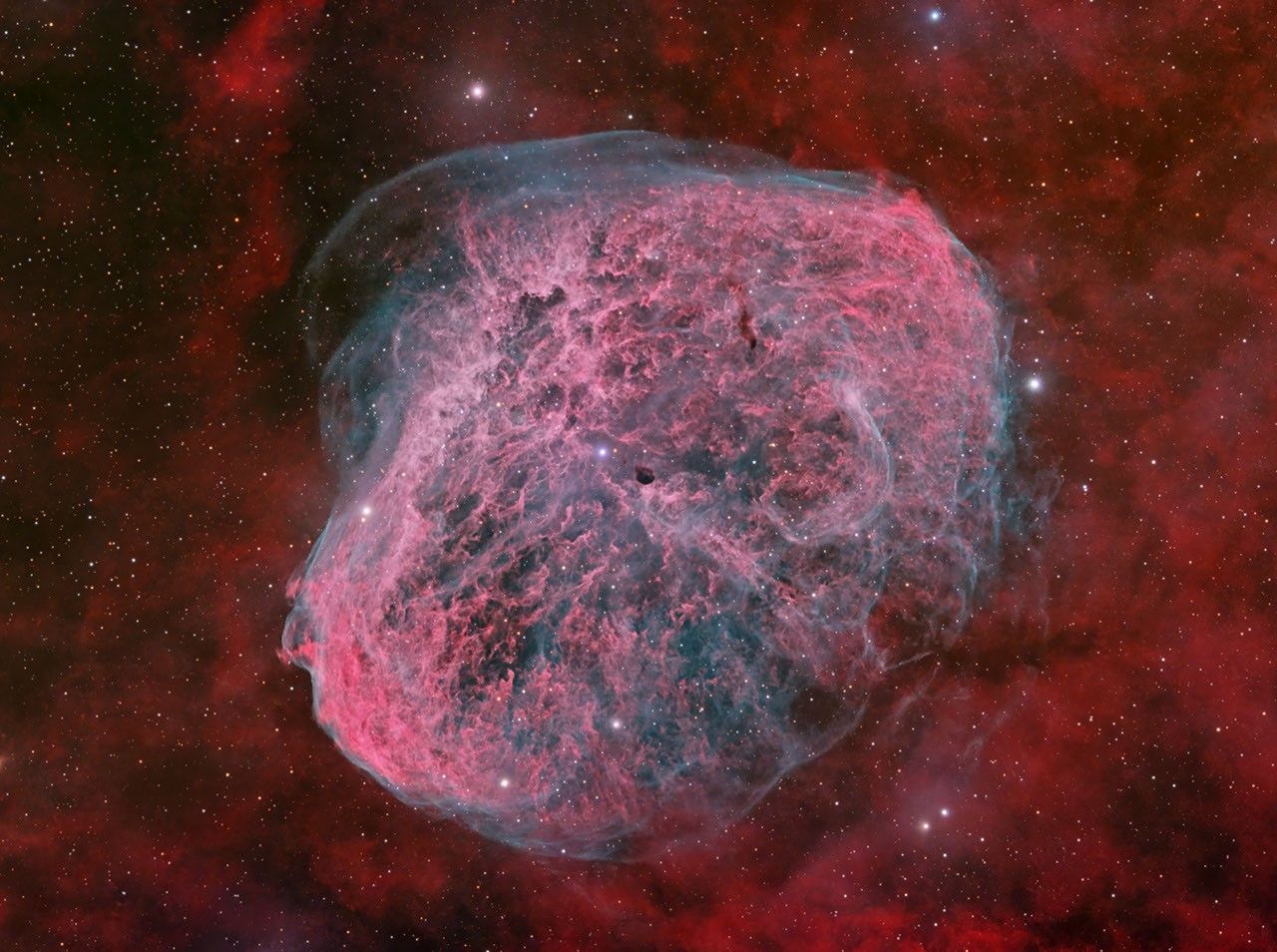
NGC 6888, also known as the Crescent Nebula, is a about 25 light-years across, a cosmic bubble blown by winds from its central, massive star. This deep telescopic image includes narrowband image data, to isolate light from hydrogen and oxygen atoms. The oxygen atoms produce the blue-green hue that seems to enshroud the nebula's detailed folds and filaments. Visible within the nebula, NGC 6888's central star is classified as a Wolf-Rayet star (WR 136). The star is shedding its outer envelope in a strong stellar wind, ejecting the equivalent of the Sun's mass every 10,000 years.
In fact, the Crescent Nebula's complex structures are likely the result of this strong wind interacting with material ejected in an earlier phase. Burning fuel at a prodigious rate and near the end of its stellar life, this star should ultimately go out with a bang in a spectacular supernova explosion. Found in the nebula rich constellation Cygnus, NGC 6888 is about 5,000 light-years away.
Text from NASA APOD.
How to see it yourself
Crescent Nebula (NGC 6888) — emission nebula in the constellation Cygnus.
- Best seen in June – August, when it stands highest around midnight.
- From New York it climbs to 88° above the horizon. Visible from latitudes -42° to 90°.
- An easy binocular target; under a dark sky it shows in a finder scope too. A UHC or OIII filter brings out its contrast.
- Constellation
- Cygnus
- Magnitude
- 7,4m
- Apparent size
- 20′ arcminutes
Whether NGC 6888 is up for you tonight, and how the clouds and the Moon look — AstroTools shows it.