Young Suns of NGC 7129
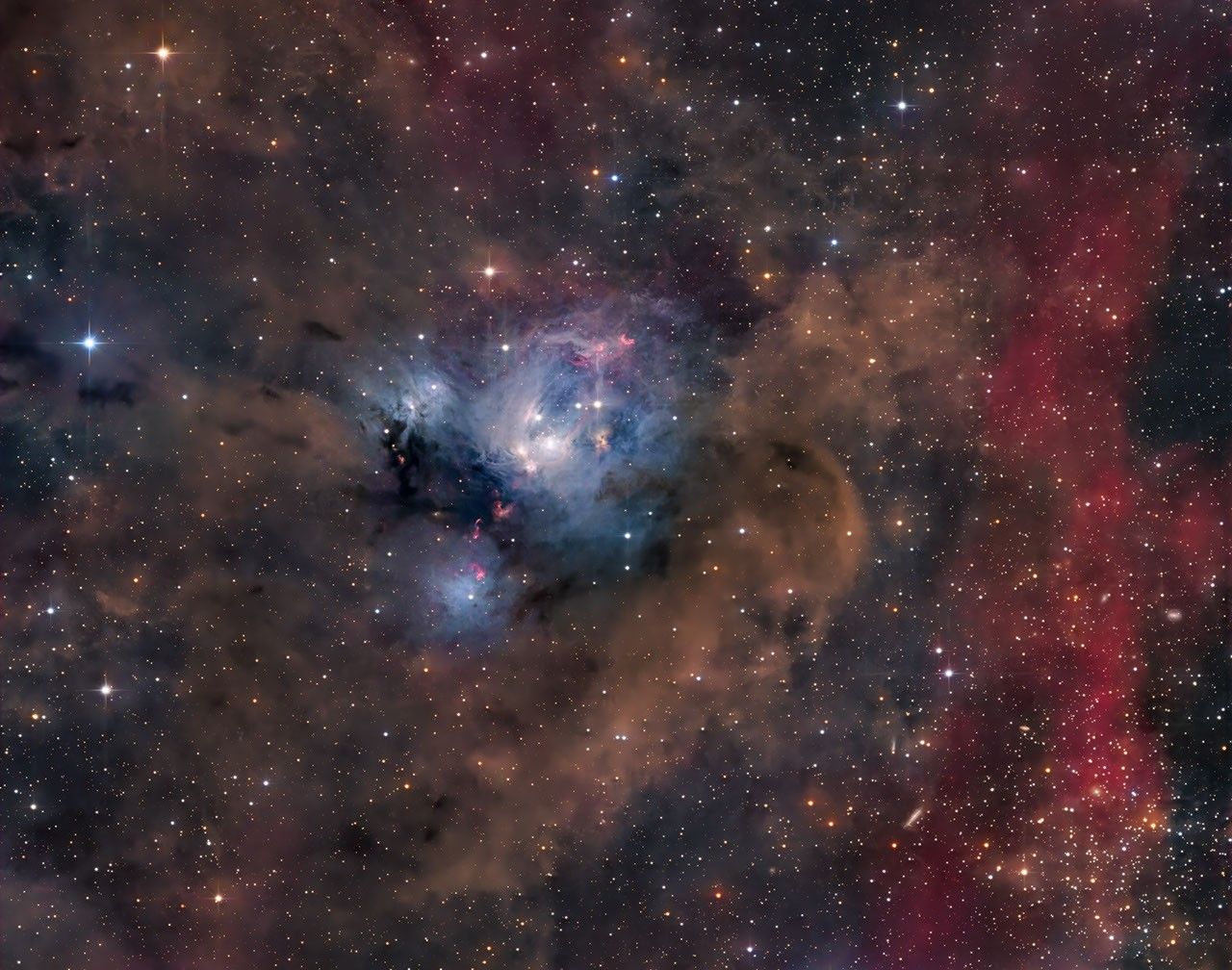
Young suns still lie within dusty NGC 7129, some 3,000 light-years away toward the royal constellation Cepheus. While these stars are at a relatively tender age, only a few million years old, it is likely that our own Sun formed in a similar stellar nursery around five billion years ago. Notable in the sharp image are the lovely bluish dust clouds that reflect the youthful starlight. But the compact, deep red crescent shapes are also markers of energetic, young stellar objects. Known as Herbig-Haro objects, their shape and color are characteristic of glowing hydrogen gas shocked by jets streaming away from newborn stars. Paler, extended filaments of reddish emission mingling with the bluish clouds are caused by dust grains effectively converting the invisible ultraviolet starlight to visible red light through photoluminesence. Ultimately the natal gas and dust in the region will be dispersed, the stars drifting apart as the loose cluster orbits the center of the Galaxy. At the estimated distance of NGC 7129, this telescopic field of view spans nearly 40 light-years.
Text from NASA APOD.
How to see it yourself
NGC 7129 — emission nebula in the constellation Cepheus.
- Best seen in July – September, when it stands highest around midnight.
- From New York it never sets and climbs to 65°. Visible from latitudes -14° to 90°.
- Needs a 150–200 mm telescope and a dark sky outside the city. A UHC or OIII filter brings out its contrast.
- Constellation
- Cepheus
- Magnitude
- 11,5m
- Apparent size
- 2,1′ arcminutes
Whether NGC 7129 is up for you tonight, and how the clouds and the Moon look — AstroTools shows it.