NGC 6357: Cathedral to Massive Stars
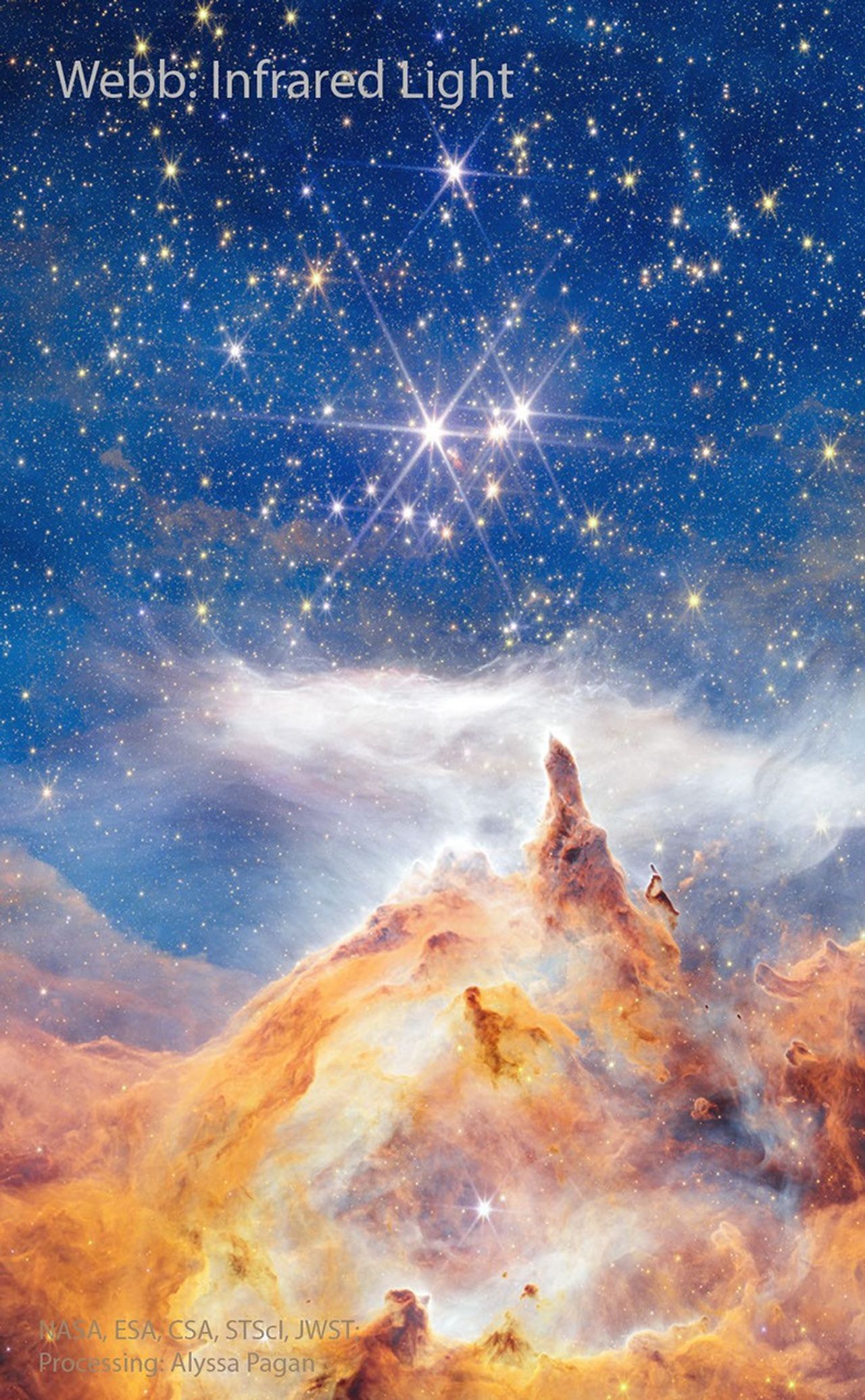
How massive can a normal star be?
Estimates made from distance, brightness and standard solar models had given one star in the open cluster Pismis 24 over 200 times the mass of our Sun, making it one of the most massive stars known.
This star is the brightest object located in the central cavity near the bottom center of the featured image taken with the Webb Space Telescope in infrared light.
For comparison, a rollover image from the Hubble Space Telescope is also featured in visible light. Close inspection of the images, however, has shown that Pismis 24-1 derives its brilliant luminosity not from a single star but from three at least.
Component stars would still remain near 100 solar masses, making them among the more massive stars currently on record.
Toward the bottom of the image, stars are still forming in the associated emission nebula NGC 6357. Appearing perhaps like a Gothic cathedral, energetic stars near the center appear to be breaking out and illuminating a spectacular cocoon.
Teachers & Students: Ideas for Utilizing APOD in the Classroom
Text from NASA APOD.
How to see it yourself
the War and Peace Nebula (NGC 6357) — emission nebula in the constellation Scorpius.
- Best seen in May – July, when it stands highest around midnight.
- From New York it climbs to 15° above the horizon. Visible from latitudes -90° to 46°.
- Needs a 150–200 mm telescope and a dark sky outside the city. A UHC or OIII filter brings out its contrast.
- Constellation
- Scorpius
- Apparent size
- 3,9′ arcminutes
Whether NGC 6357 is up for you tonight, and how the clouds and the Moon look — AstroTools shows it.