Herbig-Haro 24
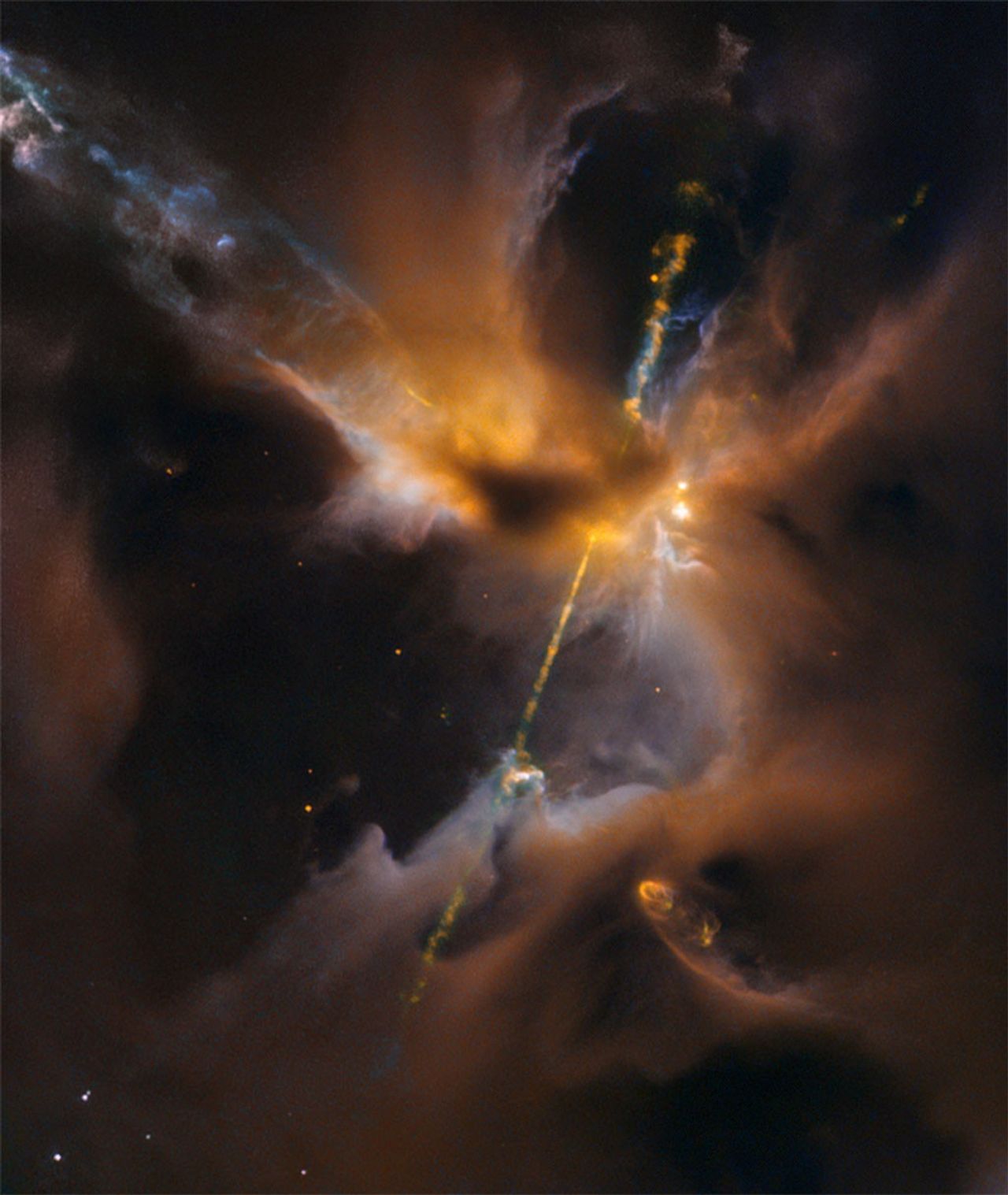
This might look like a double-bladed lightsaber, but these two cosmic jets actually beam outward from a newborn star in a galaxy near you. Constructed from Hubble Space Telescope image data, the stunning scene spans about half a light-year across Herbig-Haro 24 (HH 24), some 1,300 light-years or 400 parsecs away in the stellar nurseries of the Orion B molecular cloud complex. Hidden from direct view, HH 24's central protostar is surrounded by cold dust and gas flattened into a rotating accretion disk. As material from the disk falls toward the young stellar object, it heats up. Opposing jets are blasted out along the system's rotation axis. Cutting through the region's interstellar matter, the narrow, energetic jets produce a series of glowing shock fronts along their path.
Text from NASA APOD.
How to see it yourself
Orion B (IC 434) — emission nebula in the constellation Orion.
- Best seen in November – January, when it stands highest around midnight.
- From New York it climbs to 47° above the horizon. Visible from latitudes -82° to 78°.
- Needs a 150–200 mm telescope and a dark sky outside the city. A UHC or OIII filter brings out its contrast.
- Constellation
- Orion
- Magnitude
- 11,0m
- Apparent size
- 90′ arcminutes
Whether IC 434 is up for you tonight, and how the clouds and the Moon look — AstroTools shows it.