NGC 6164: A Dragon’s Egg
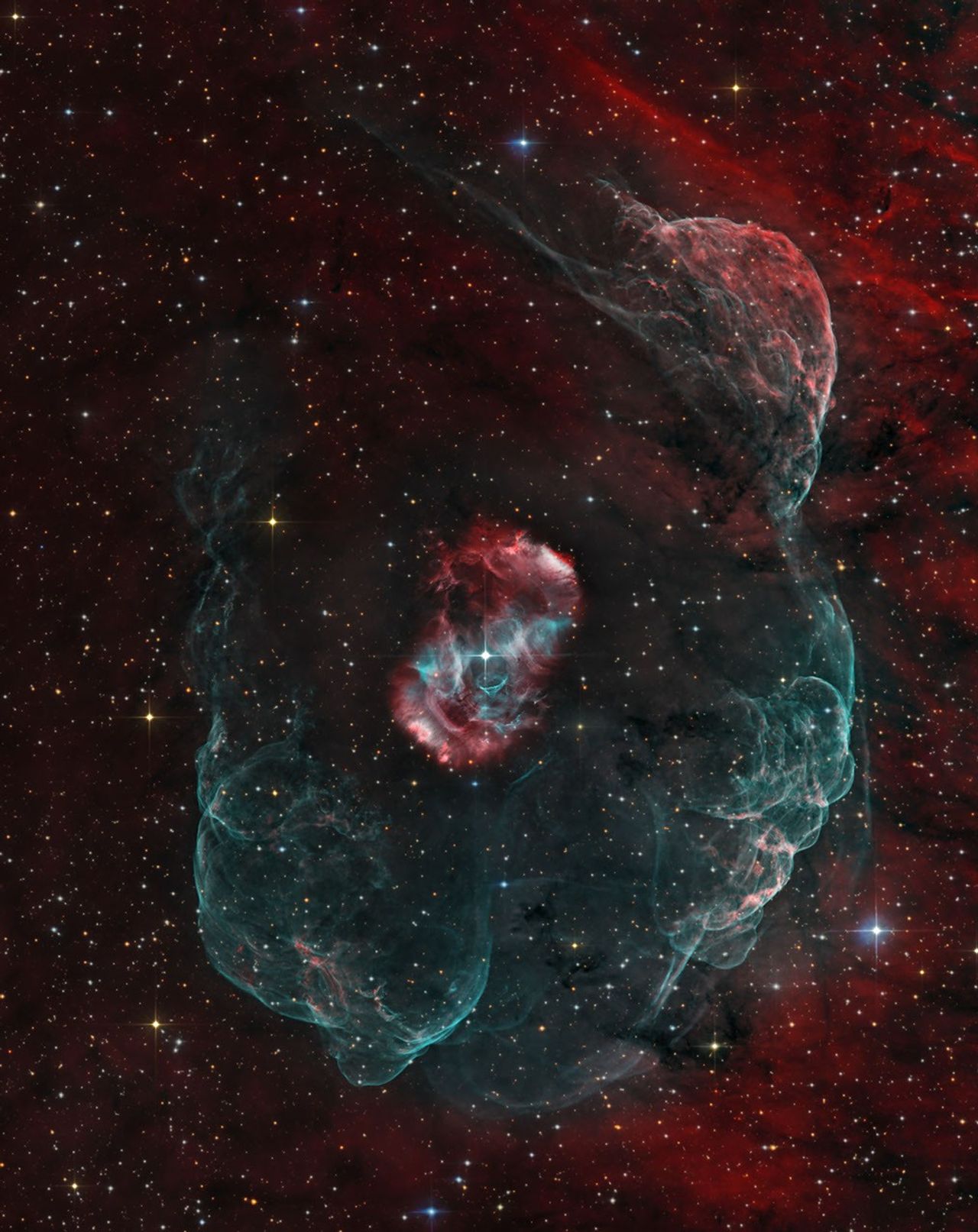
Beautiful emission nebula NGC 6164 was created by a rare, hot, luminous O-type star, some 40 times as massive as the Sun. Seen at the center of the cosmic cloud, the star is a mere 3 to 4 million years old. In another three to four million years the massive star will end its life in a supernova explosion . Spanning around 4 light-years, the nebula itself has a bipolar symmetry. That makes it similar in appearance to more common and familiar planetary nebulae – the gaseous shrouds surrounding dying sun-like stars. Also like many planetary nebulae, NGC 6164 has been found to have an extensive, faint halo , revealed in this deep image of the region. Expanding into the surrounding interstellar medium , the material in the halo is likely from an earlier active phase of the O star. This gorgeous telescopic view is a composite of extensive narrow-band image data, highlighting glowing atomic hydrogen gas in red and oxygen in greenish hues, with broad-band data for the surrounding starfield. Also known as the Dragon’s Egg nebula , NGC 6164 is 4,200 light-years away in the right-angled southern constellation of Norma .
Text from NASA APOD.
How to see it yourself
NGC 6164 — emission nebula in the constellation Norma.
- Best seen in April – June, when it stands highest around midnight.
- From New York it climbs to 1° above the horizon. Visible from latitudes -90° to 32°.
- An easy binocular target; under a dark sky it shows in a finder scope too. A UHC or OIII filter brings out its contrast.
- Constellation
- Norma
- Magnitude
- 6,7m
- Apparent size
- 1,4′ arcminutes
Whether NGC 6164 is up for you tonight, and how the clouds and the Moon look — AstroTools shows it.