Messier 81
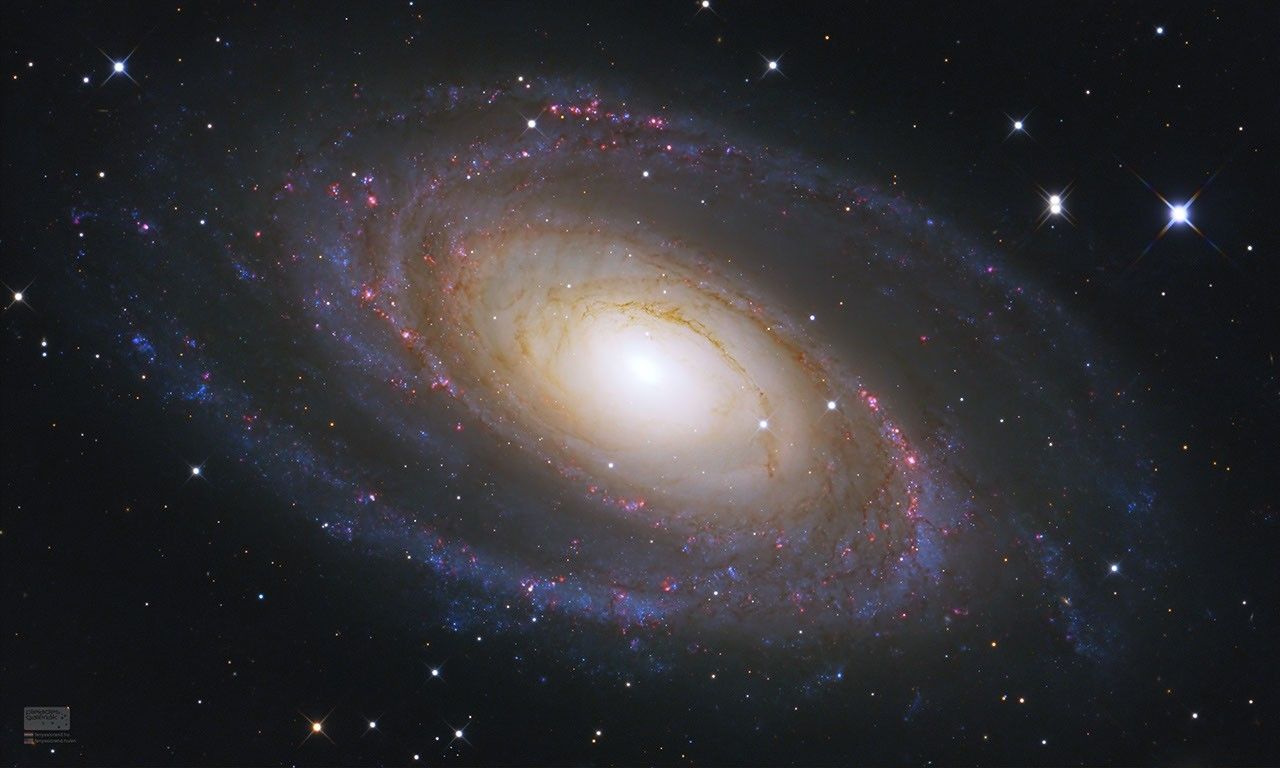
One of the brightest galaxies in planet Earth’s sky is similar in size to our Milky Way Galaxy: big, beautiful Messier 81 . Also known as NGC 3031 or Bode’s galaxy for its 18th century discoverer, this grand spiral can be found toward the northern constellation of Ursa Major, the Great Bear. The sharp, detailed telescopic view reveals M81’s bright yellow nucleus, blue spiral arms, pinkish starforming regions, and sweeping cosmic dust lanes . But some dust lanes actually cut across the galactic disk (left of center), contrary to other prominent spiral features. The errant dust lanes may be the lingering result of a close encounter between M81 and the nearby galaxy M82 lurking outside of this frame. Scrutiny of variable stars in M81 has yielded a well-determined distance for an external galaxy — 11.8 million light-years.
Text from NASA APOD.
How to see it yourself
Bode's Galaxy (M81) — galaxy in the constellation Ursa Major.
- Best seen in January – March, when it stands highest around midnight.
- From New York it never sets and climbs to 62°. Visible from latitudes -11° to 90°.
- An easy binocular target; under a dark sky it shows in a finder scope too.
- Constellation
- Ursa Major
- Magnitude
- 6,9m
- Apparent size
- 21,6′ arcminutes
Whether M81 is up for you tonight, and how the clouds and the Moon look — AstroTools shows it.