Messier 87
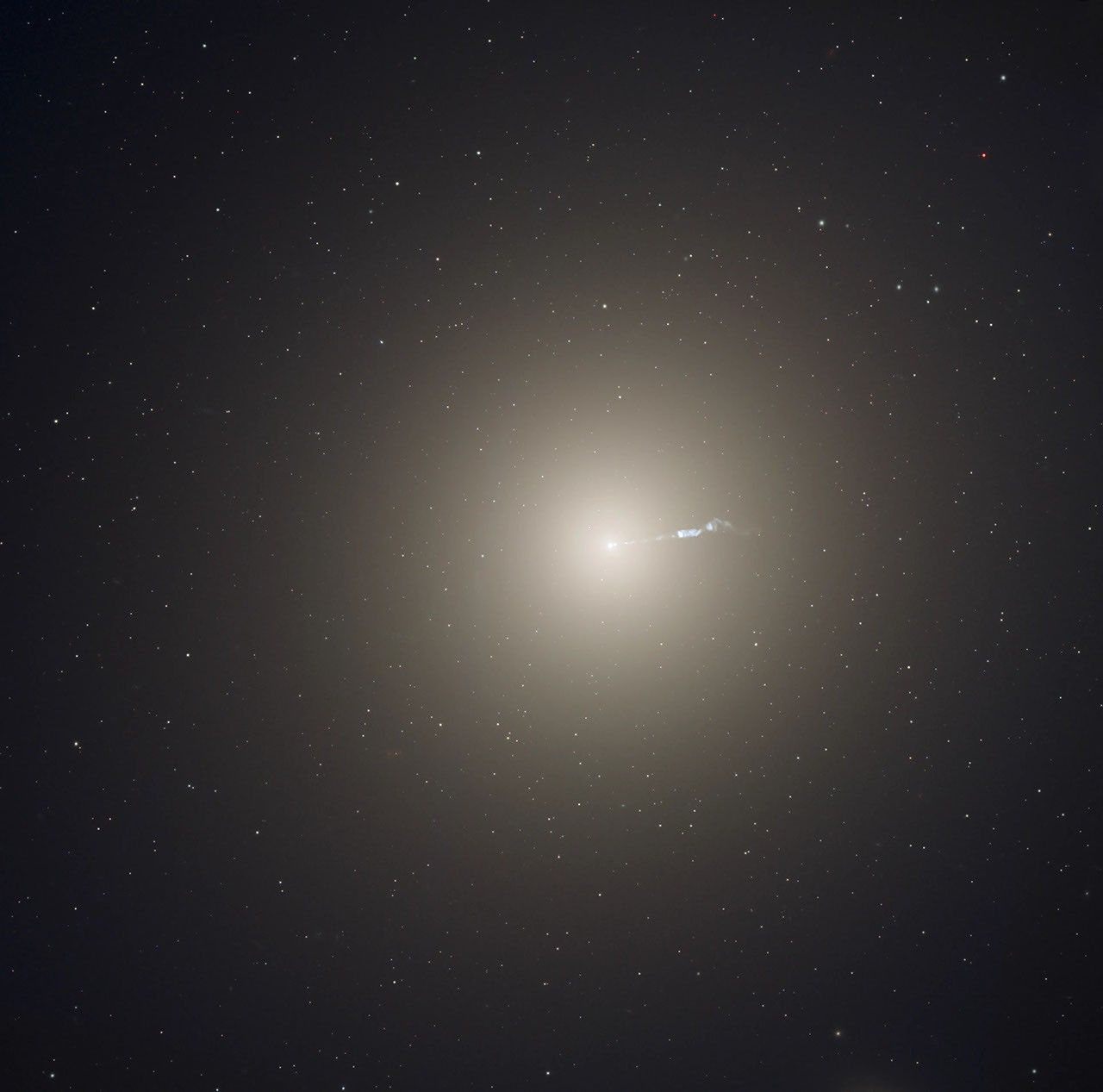
Enormous elliptical galaxy Messier 87 is about 50 million light-years away. Also known as NGC 4486, the giant galaxy holds trillions of stars compared to the mere billions of stars in our large spiral Milky Way. M87 reigns as the large central elliptical galaxy in the Virgo galaxy cluster . An energetic jet from the giant galaxy’s core is seen to stretch outward for about 5,000 light-years in this sharp optical and near-infrared view from the Hubble Space Telescope. In fact, the cosmic blow torch is seen across the electromagnetic spectrum from gamma-rays to radio wavelengths . Its ultimate power source is M87’s central, supermassive black hole. An image of this monster in the middle of M87 has been captured by planet Earth’s Event Horizon Telescope.
Text from NASA APOD.
How to see it yourself
Virgo Galaxy (M87) — galaxy in the constellation Virgo.
- Best seen in February – April, when it stands highest around midnight.
- From New York it climbs to 62° above the horizon. Visible from latitudes -68° to 90°.
- Needs a small telescope, 70–100 mm, and a sky free of light pollution.
- Constellation
- Virgo
- Magnitude
- 9,0m
- Apparent size
- 7,1′ arcminutes
Whether M87 is up for you tonight, and how the clouds and the Moon look — AstroTools shows it.