Colors of the Moon
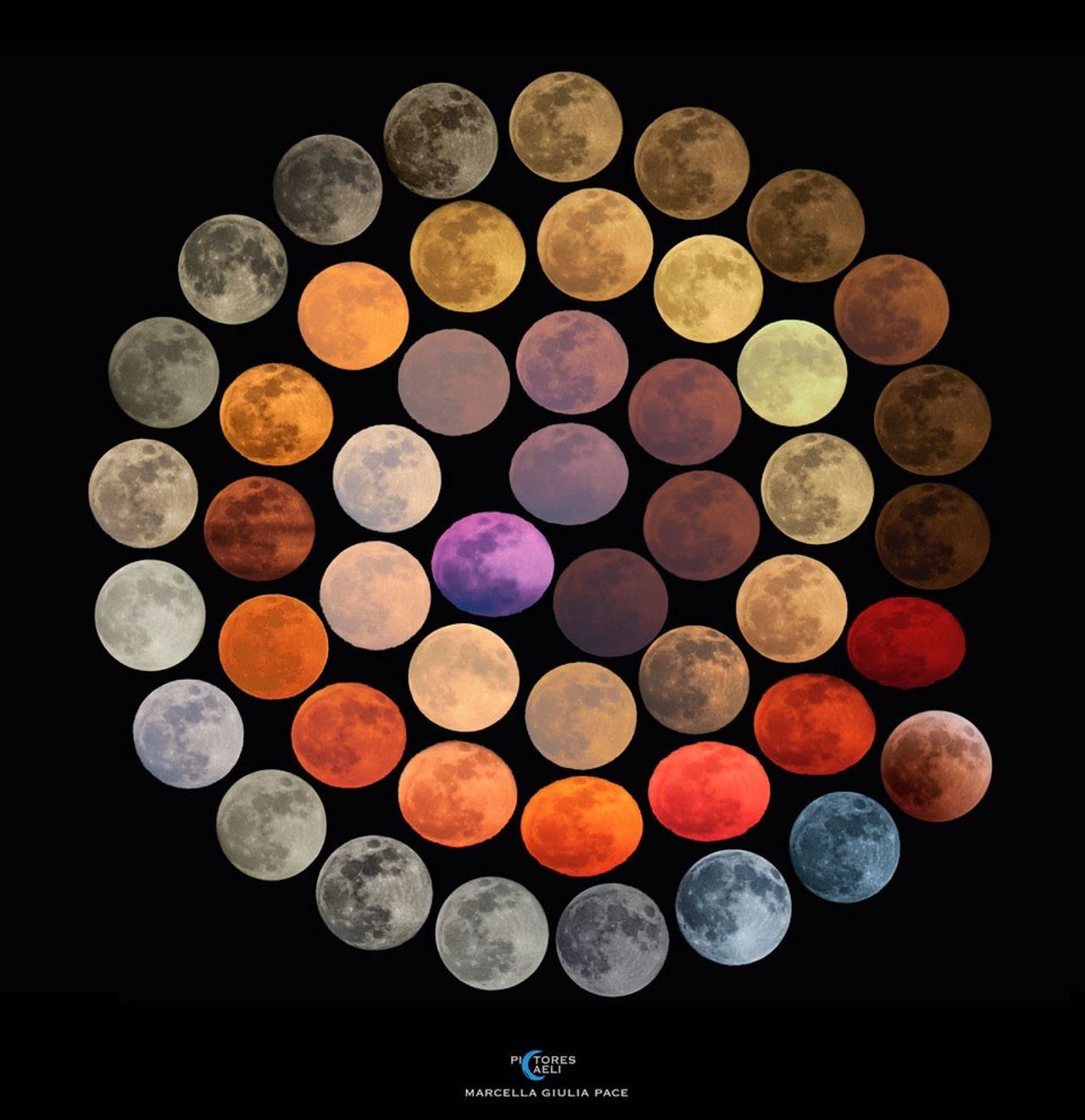
What color is the Moon? It depends on the night — and the time. Outside of the Earth’s atmosphere, the dark Moon, which shines by reflected sunlight, appears a magnificently brown-tinged gray. The featured image highlights a collection of apparent colors of the full moon on Earth, documented by one astrophotographer over 10 years from different locations across Italy. A red– or yellow-colored moon usually indicates a moon seen near the horizon. There, some of the blue light has been scattered away by a long path through the Earth’s atmosphere, sometimes laden with fine dust. A blue-colored moon is more rare and can indicate an atmosphere carrying larger dust particles. What created the purple moon is unclear — it may be a combination of several effects. The last image captures the total lunar eclipse of 2018 July — where the moon, in Earth’s shadow, appeared a faint red — due to light refracted through air around the Earth. Have you ever seen an unusually colorful Moon?
Text from NASA APOD.
How to see it yourself
Moon phase, moonrise and moonset for your city — on the Moon page.