CG 4: The Globule and the Galaxy
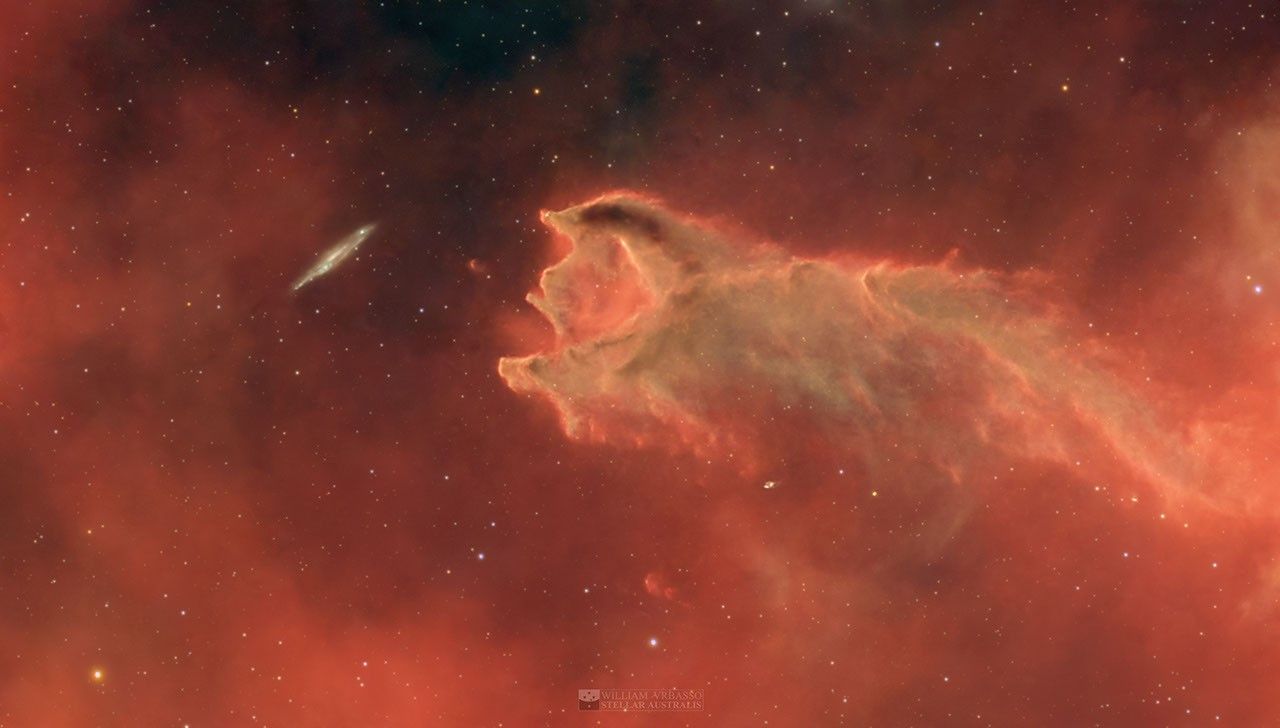
Is this a cosmic monster ready to devour an unsuspecting galaxy? Thankfully, that is not the case. The red “monster” shown in the featured image is Cometary Globule CG 4, 1,300 light-years away in the Constellation Puppis. CG 4 is a molecular cloud, where hydrogen becomes cold enough to form molecules that can be brought together by gravity to create stars. The shape of CG 4 resembles that of a comet, but its head is 1.5 light-year in diameter and its tail is 8 light-years long; for comparison, the distance from the Earth to the sun is only 8 light-minutes. Astronomers believe that the tail of a cometary globule could have been shaped by a nearby supernova explosion or by irradiation from hot, massive stars. Indeed, CG 4 and other nearby globules point away from the Vela Supernova Remnant, at the center of the Gum Nebula. The edge-on spiral galaxy, ESO 257-19, is more than a hundred million light-years beyond CG 4, and is completely safe from the “monster”.
Text from NASA APOD.
How to see it yourself
Will the sky be clear tonight, and what is there to find — in AstroTools.