Andromeda and Friends
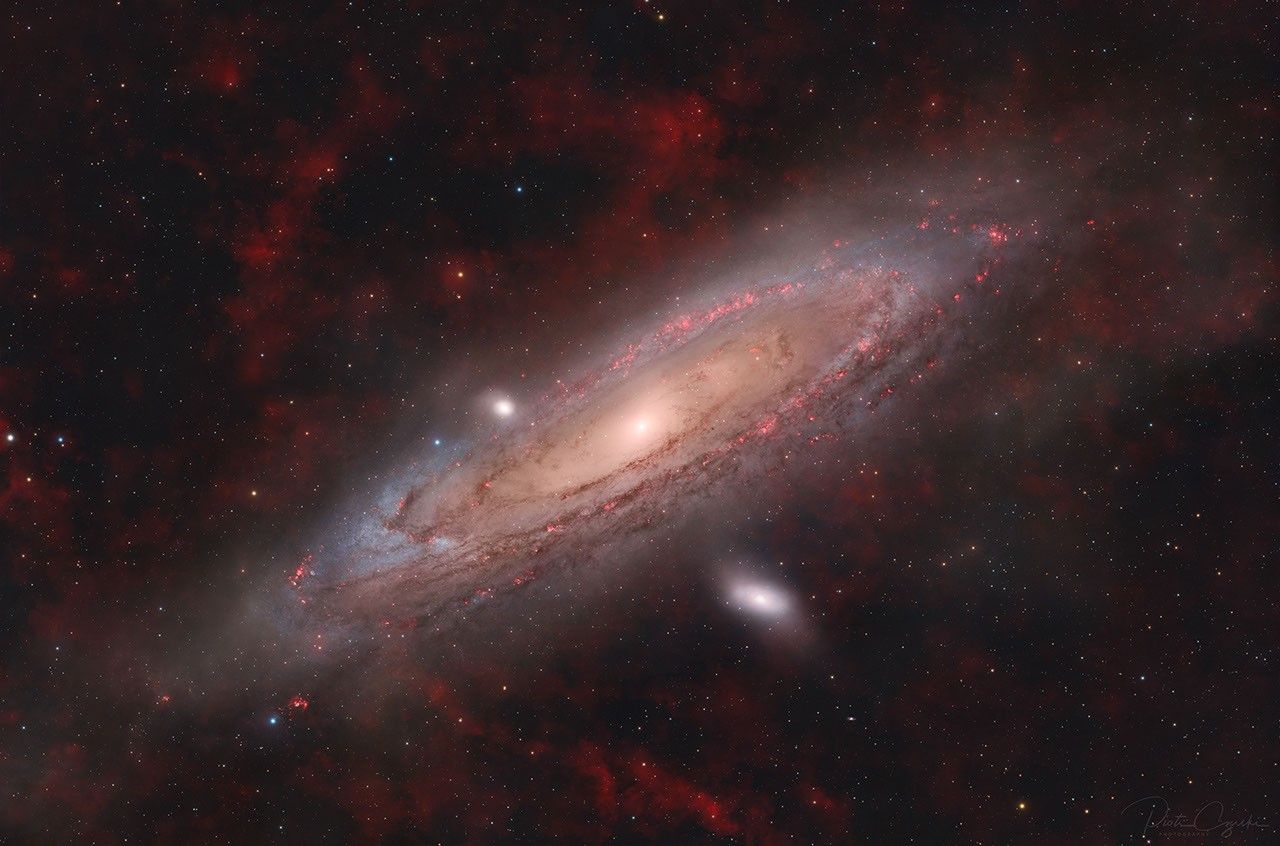
This magnificent extragalactic skyscape looks toward the Andromeda Galaxy, the closest large spiral galaxy to the Milky Way. It also accomplishes a Messier catalog trifecta by including Andromeda, cataloged as Messier 31 (M31), along with Messier 32 (M32), and Messier 110 (M110) in the same telescopic field of view.
In this frame, M32 is just left of the Andromeda Galaxy's bright core with M110 below and to the right. M32 and M110 are both elliptical galaxies themselves and satellites of the larger spiral Andromeda. By combining 60 hours of broadband and narrowband image data, the deep telescopic view also reveals tantalizing details of dust lanes, young star clusters, and star-forming regions along Andromeda's spiral arms, and faint, foreground clouds of glowing hydrogen gas. For now, Andromeda and friends are some 2.5 million light-years from our own large spiral Milky Way.
Fun Fact: It has been 11,111 days since APOD was founded.
Text from NASA APOD.
How to see it yourself
Andromeda Galaxy (M31) — galaxy in the constellation Andromeda.
- Best seen in August – October, when it stands highest around midnight.
- From New York it climbs to 89° above the horizon. Visible from latitudes -39° to 90°.
- Visible to the naked eye under a dark sky away from city lights.
- Constellation
- Andromeda
- Magnitude
- 3,4m
- Apparent size
- 177,8′ arcminutes
Whether M31 is up for you tonight, and how the clouds and the Moon look — AstroTools shows it.