47 Tucanae: Globular Star Cluster
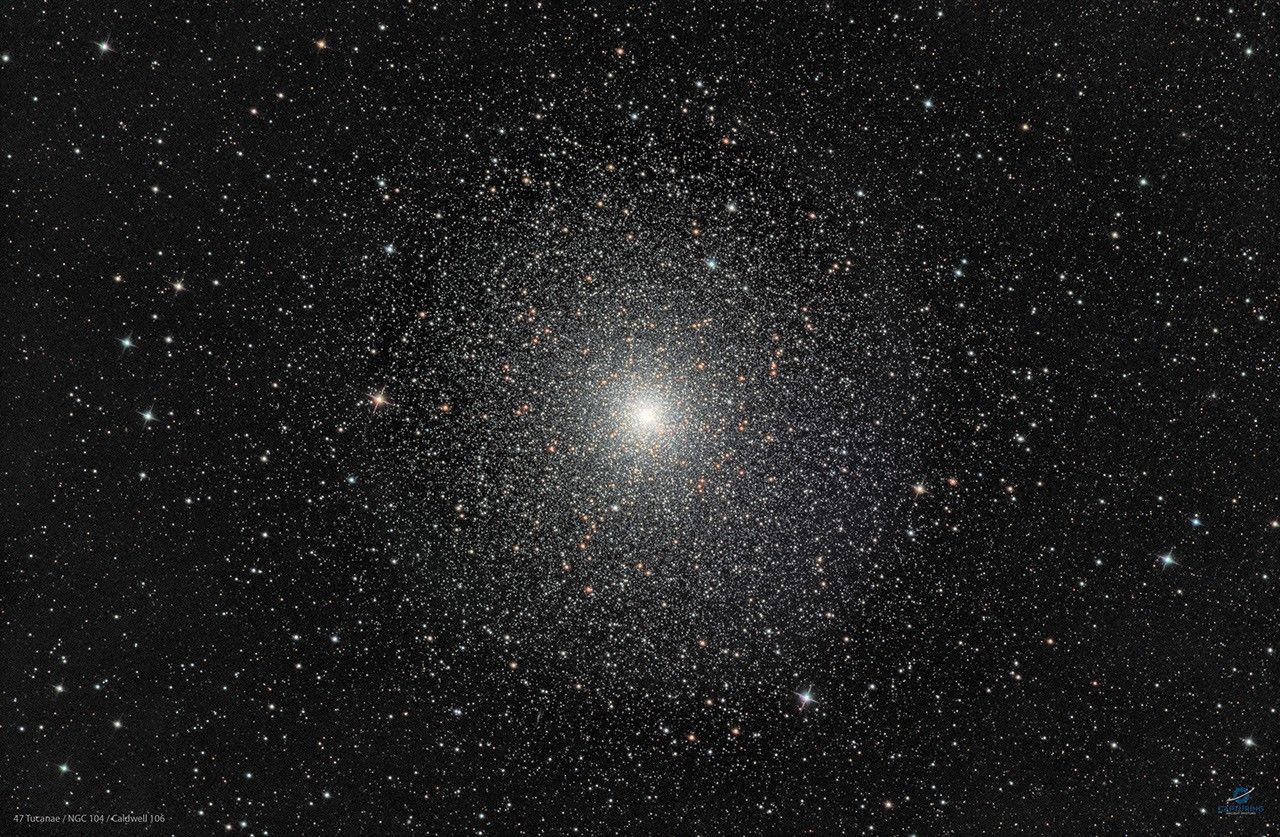
Also known as NGC 104, 47 Tucanae is a jewel of the southern sky. Not a star but a dense cluster of stars, it roams the halo of our Milky Way Galaxy along with some 200 other globular star clusters. The second brightest globular cluster (after Omega Centauri) as seen from planet Earth, 47 Tuc lies about 13,000 light-years away. It can be spotted with the naked eye close on the sky to the Small Magellanic Cloud in the constellation of the Toucan. The dense cluster is made up of hundreds of thousands of stars in a volume only about 120 light-years across. Red giant stars on the outskirts of the cluster are easy to pick out as yellowish stars in this sharp telescopic portrait. Tightly packed globular star cluster 47 Tuc is also home to a star with the closest known orbit around a black hole.
Text from NASA APOD.
How to see it yourself
47 Tuc Cluster (NGC 104) — globular star cluster in the constellation Tucana.
- Best seen in August – October, when it stands highest around midnight.
- From New York it never rises: you need to be further south. Visible from latitudes -90° to 8°.
- Visible to the naked eye under a dark sky away from city lights.
- Constellation
- Tucana
- Magnitude
- 4,1m
- Apparent size
- 31,8′ arcminutes
Whether NGC 104 is up for you tonight, and how the clouds and the Moon look — AstroTools shows it.