Blue Arcs Toward Andromeda
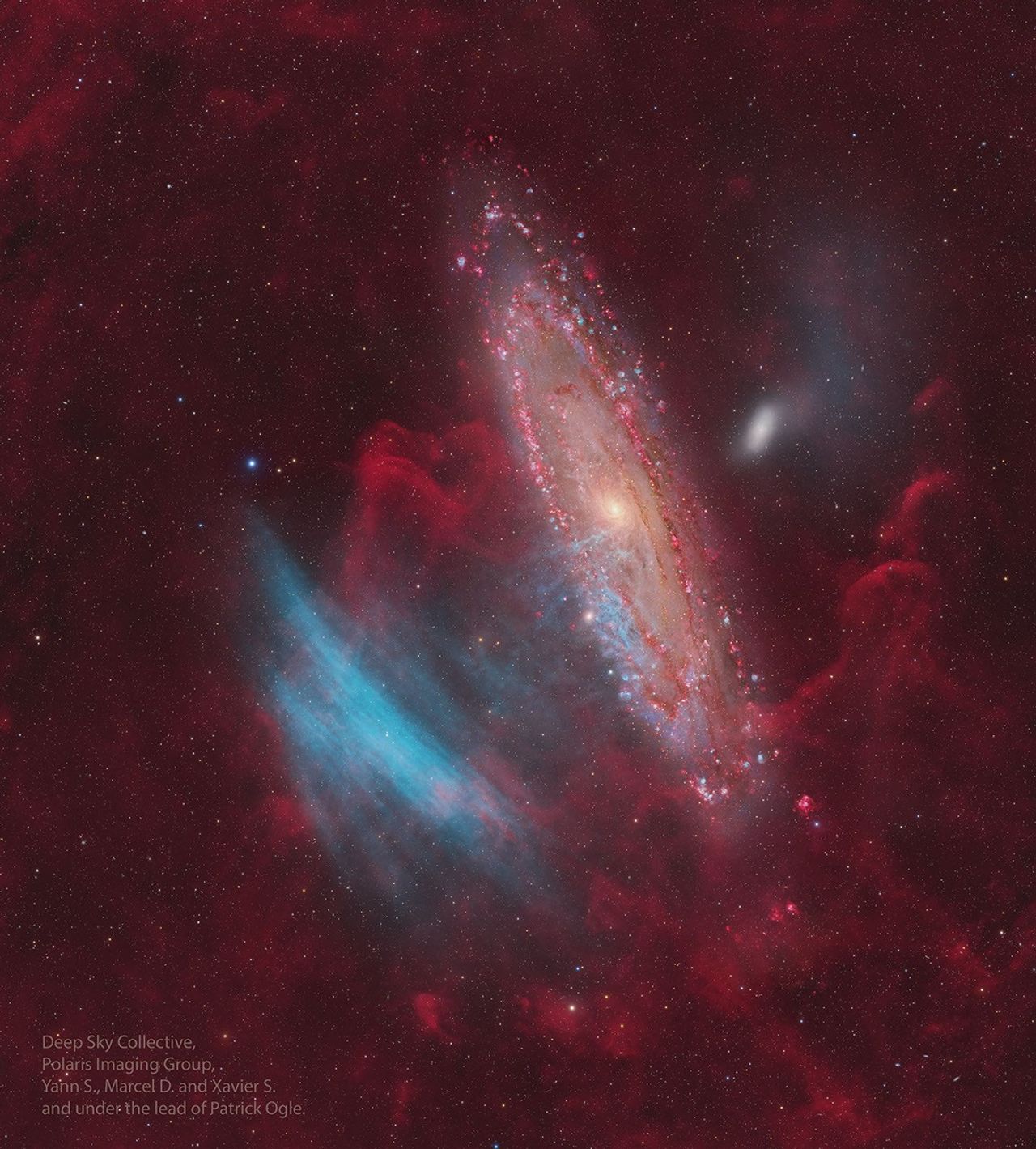
What are these gigantic blue arcs near the Andromeda Galaxy (M31)?
Discovered in 2022 by amateur astronomers, the faint arcs -- dubbed SDSO 1 -- span nearly the same angular size as M31 itself.
At first, their origin was a mystery: are they actually near the Andromeda Galaxy, or alternatively near to our Sun?
Now, over 550 hours of combined exposure and a collaboration between amateur and professional astronomers has revealed strong evidence for their true nature: SDSO 1 is not intergalactic, but a new class of planetary nebula within our galaxy.
Dubbed a Ghost Planetary Nebula (GPN), SDSO 1 is the first recognized member of a new subclass of faded planetary nebulas, along with seven others also recently identified.
Shown in blue are extremely faint oxygen emission from the shock waves, while the surrounding red is a hydrogen-emitting trail that indicates the GPN's age.
Text from NASA APOD.
How to see it yourself
Andromeda Galaxy (M31) — galaxy in the constellation Andromeda.
- Best seen in August – October, when it stands highest around midnight.
- From New York it climbs to 89° above the horizon. Visible from latitudes -39° to 90°.
- Visible to the naked eye under a dark sky away from city lights.
- Constellation
- Andromeda
- Magnitude
- 3,4m
- Apparent size
- 177,8′ arcminutes
Whether M31 is up for you tonight, and how the clouds and the Moon look — AstroTools shows it.