Rosette Nebula Deep Field
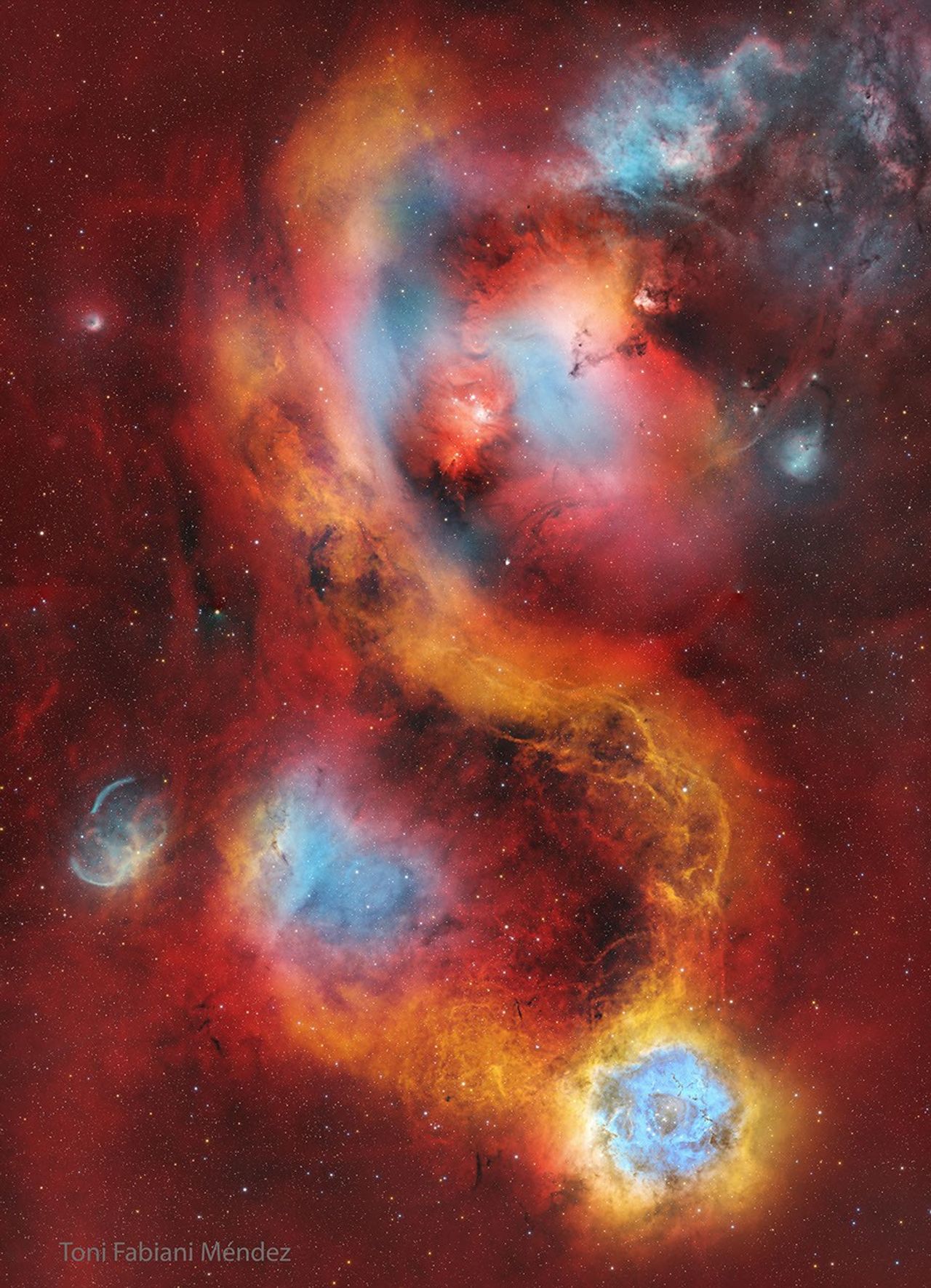
Can you find the Rosette Nebula? The red flowery-looking nebula just above the image center may seem a good choice, but that's not it.
The famous Rosette Nebula is really located on the lower right, here colored blue and white, and connected to the other nebulas by gold-colored filaments.
Because the featured image of Rosette's field is so wide, and because of its deep red exposure, it seems to contain other flowers.
Designated NGC 2237, the center of the Rosette Nebula is populated by the bright blue stars of open cluster NGC 2244, whose winds and energetic light are evacuating the nebula's center.
The Rosette Nebula is about 5,000 light years distant and, just by itself, spans about three times the diameter of a full moon. This flowery field can be found toward the constellation of the Unicorn (Monoceros).
Explore Your Universe: Random APOD Generator
Text from NASA APOD.
How to see it yourself
Rosette Nebula (NGC 2238) — emission nebula in the constellation Monoceros.
- Best seen in November – January, when it stands highest around midnight.
- From New York it climbs to 54° above the horizon. Visible from latitudes -75° to 85°.
- An easy binocular target; under a dark sky it shows in a finder scope too. A UHC or OIII filter brings out its contrast.
- Constellation
- Monoceros
- Magnitude
- 6,0m
- Apparent size
- 80′ arcminutes
Whether NGC 2238 is up for you tonight, and how the clouds and the Moon look — AstroTools shows it.