NGC 6366 vs 47 Ophiuchi
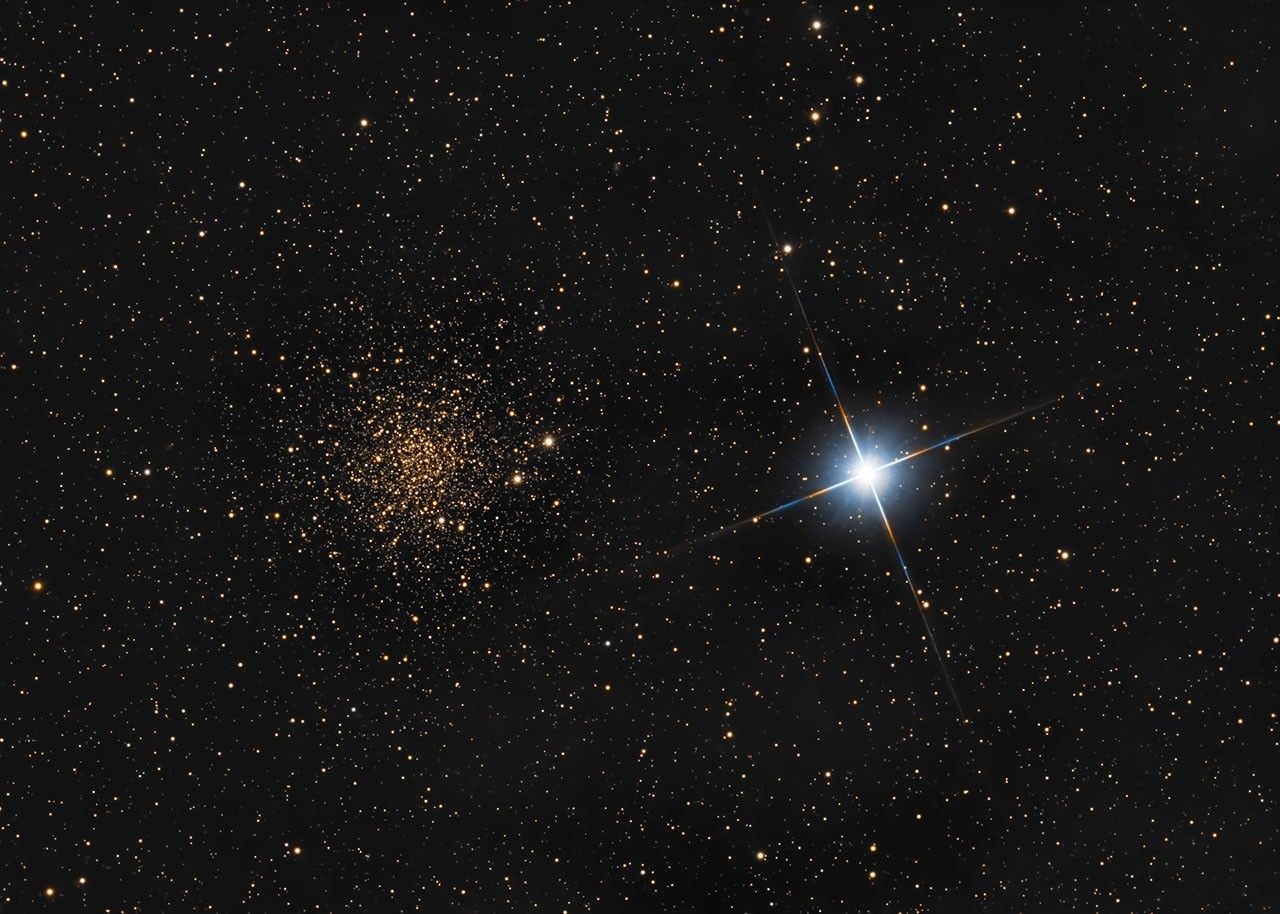
Most globular star clusters roam the halo of our Milky Way galaxy, but globular cluster NGC 6366 lies close to the galactic plane. About 12,000 light-years away toward the constellation Ophiuchus, the cluster's starlight is dimmed and reddened by the Milky Way's interstellar dust when viewed from planet Earth. As a result, the stars of NGC 6366 look almost golden in this telescopic scene, especially when seen next to relatively bright, bluish, and nearby star 47 Ophiuchi. Compared to the hundred thousand stars or so gravitationally bound in distant NGC 6366, 47 Oph itself is a binary star system a mere 100 light-years away. Still, the co-orbiting stars of 47 Oph are too close together to be individually distinguished in the image.
Text from NASA APOD.
How to see it yourself
NGC 6366 — globular star cluster in the constellation Ophiuchus.
- Best seen in May – July, when it stands highest around midnight.
- From New York it climbs to 44° above the horizon. Visible from latitudes -85° to 75°.
- Needs a 150–200 mm telescope and a dark sky outside the city.
- Constellation
- Ophiuchus
- Apparent size
- 13,8′ arcminutes
Whether NGC 6366 is up for you tonight, and how the clouds and the Moon look — AstroTools shows it.