Dust Shells around WR 140 from Webb
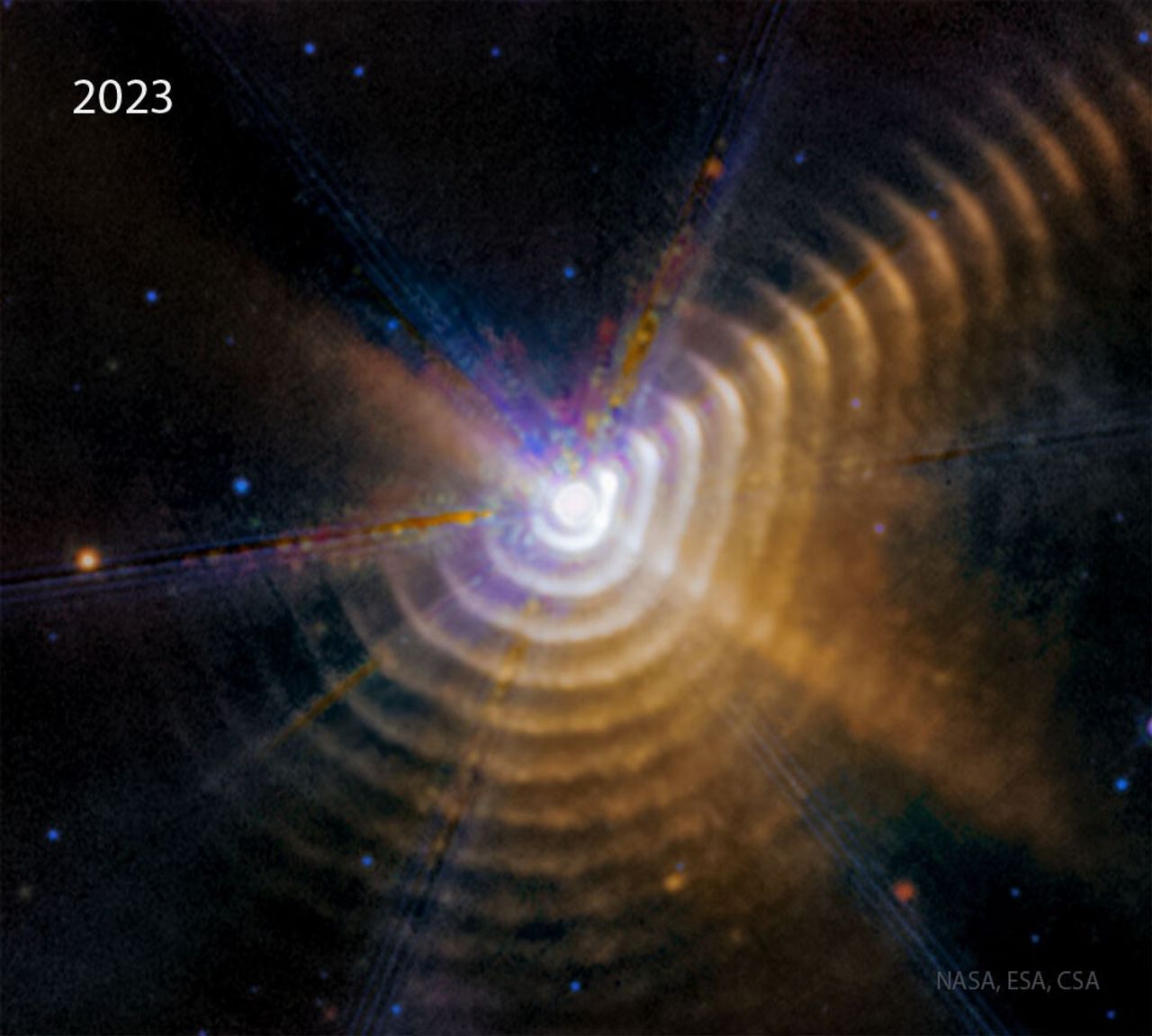
What are those strange rings? Rich in dust, the rings are likely 3D shells — but how they were created remains a topic of research . Where they were created is well known: in a binary star system that lies about 6,000 light years away toward the constellation of the Swan (Cygnus) — a system dominated by the Wolf-Rayet star WR 140 . Wolf-Rayet stars are massive, bright, and known for their tumultuous winds . They are also known for creating and dispersing heavy elements such as carbon , which is a building block of interstellar dust . The other star in the binary is also bright and massive — but not as active . The two great stars joust in an oblong orbit as they approach each other about every eight years. When at closest approach, the X-ray emission from the system increases, as, apparently, does the dust expelled into space — creating another shell . The featured infrared image by the Webb Space Telescope resolves greater details and more dust shells than ever before. Images taken over consecutive years show the shells moving outward .
Text from NASA APOD.
How to see it yourself
Will the sky be clear tonight, and what is there to find — in AstroTools.