Stardust in the Perseus Molecular Cloud
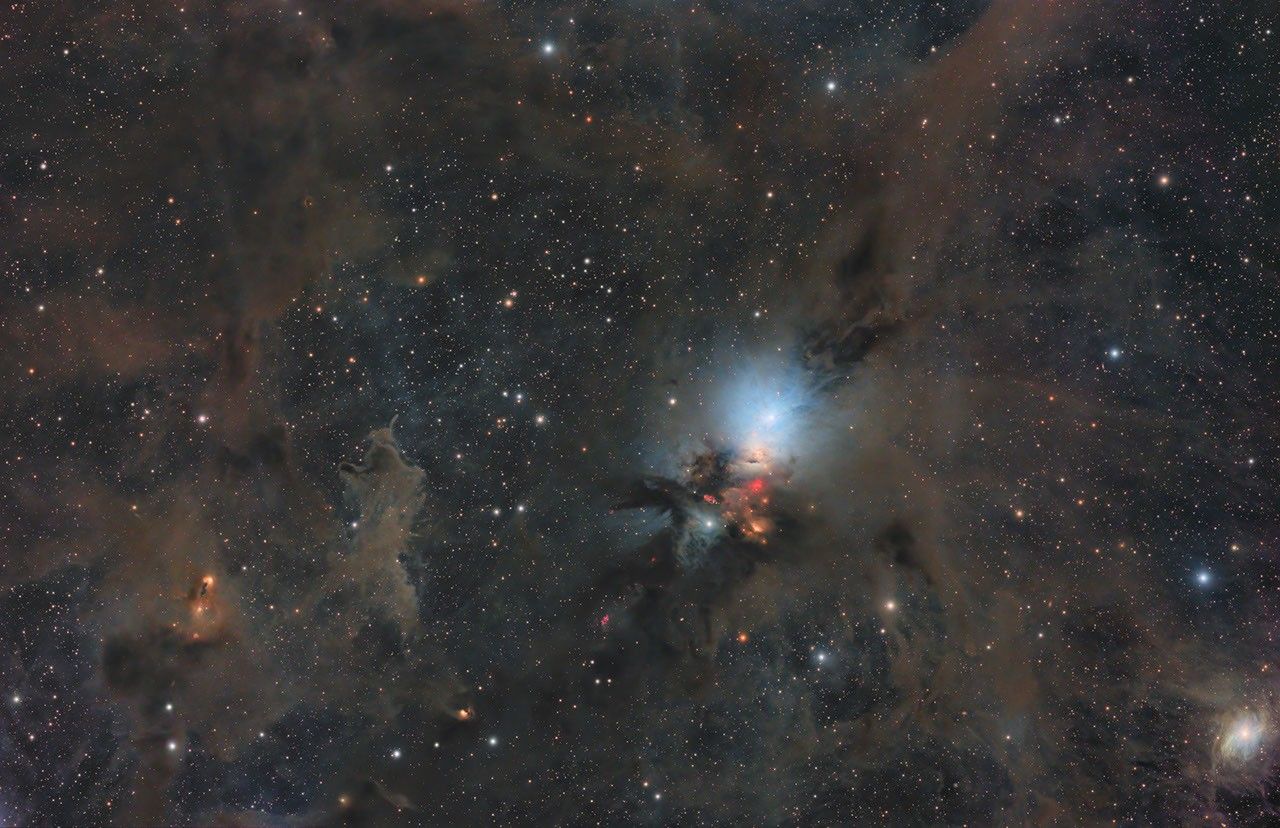
Clouds of stardust drift through this deep skyscape , across the Perseus molecular cloud some 850 light-years away. Dusty nebulae reflecting light from embedded young stars stand out in the nearly 4 degree wide field of view. With a characteristic bluish color reflection nebula NGC 1333 is prominent near center. Hints of contrasting red emission from Herbig-Haro objects, the jets and shocked glowing gas emanating from recently formed stars, are scattered across the dusty expanse . While many stars are forming in the molecular cloud, most are obscured at visible wavelengths by the pervasive dust. The chaotic environment surrounding NGC 1333 may be similar to one in which our own Sun formed over 4.5 billion years ago. At the estimated distance of the Perseus molecular cloud, this cosmic scene would span about 80 light-years. Growing Gallery: Comet ATLAS (G3)
Text from NASA APOD.
How to see it yourself
NGC 1333 — emission nebula in the constellation Perseus.
- Best seen in October – December, when it stands highest around midnight.
- From New York it climbs to 81° above the horizon. Visible from latitudes -49° to 90°.
- Needs a 150–200 mm telescope and a dark sky outside the city. A UHC or OIII filter brings out its contrast.
- Constellation
- Perseus
- Magnitude
- 10,9m
- Apparent size
- 19,5′ arcminutes
Whether NGC 1333 is up for you tonight, and how the clouds and the Moon look — AstroTools shows it.